The Doors of Perception Are Open
It is possible to live in a place and yet not live there. A city of millions can buzz with activity and yet lack engagement. How often we walk down the streets in a daze, not even aware of the rich mosaic that surrounds us! The urban jungle overwhelms the senses, and after some time, the initial wonder wears away and we shuffle here and there. The city offers no fewer riches than the forest. Many people pass through both landscapes without stopping to look closer at the elements that make the whole. And when we do stop to look at the wildflower, the tree, the insect, the bird--we are frustrated by our own lack of knowledge. Similarly, we may stop before a particular edifice, interested in its form but frustrated that we cannot know what it has to tell.
Nature enthusiasts may resort to reference books, or they may turn to a more experienced trekker. Urban explorers, too, might find answers in architectural guides or historical almanacs. All too often, however, this requires time and effort that we cannot (or do not wish to) appropriate for our self-edification.
The city of Toronto has come up with a quick fix for those of us who have wondered about various urban specimens but haven't followed up our curiosity with diligent study. Once a year, 140 Toronto buildings open their doors to the public. The buildings are a mixture of public and private, historical and modern establishments. They are scattered around the city, and twelve hours--from 10:00 AM to 4:00 PM both Saturday and Sunday--are obviously not enough to see even a small fraction of the total offerings. Therefore, it is important to be strategic about your building selection, since you don't want to waste your time getting from one place to another.
We were fortunate in that our apartment is located in the heart of downtown. Transportation did not concern us; our legs were enough to get us where we wanted to go. Being newcomers to the city was also helpful since all the offerings were new to us.
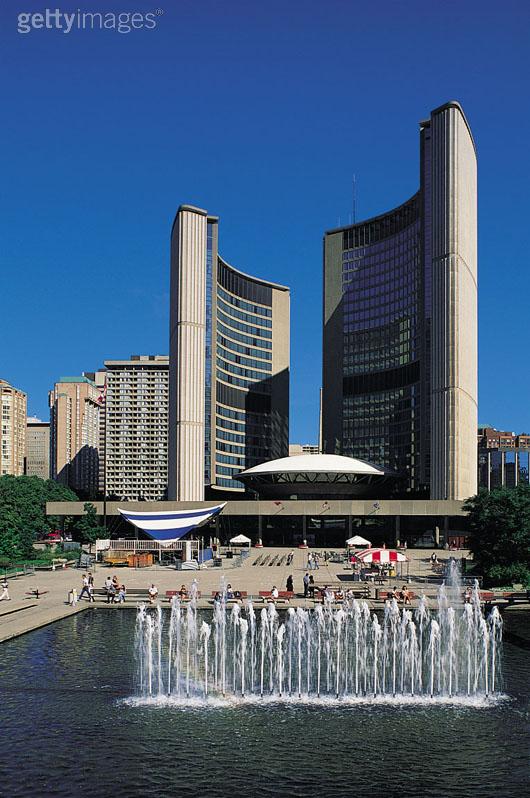
On the first day we began by walking two blocks to Toronto's City Hall. It is perhaps one of the more distinctive buildings in the city, as anyone who has been to the city will confirm. Some say it looks like a big eye; others say it's like a clam with a pearl. Amidst the more traditional architecture of the city, it certainly stands out. I had been inside many times to use the small public library branch that is housed there--the closest one to our apartment. But I had never explored the inside of the building and was excited to find out finally what that dome covered thing in the middle is. What looks like the bridge of some starship is the council chamber, where the city's elected officials meet. It is something like a space-age amphitheater or Greek public forum. The whole building has that mid-century aesthetic, prominent in the 1950s and 1960s, that makes you feel like you've walked onto the set of 2001: A Space Odyssey. Though somewhat dated, the architecture evokes a sense of awe. It is still a daring design, which is very forward looking. The entire council chamber floats between the two wings, supported by a sole pylon. The enormous column descends to the foundation through the lobby of City Hall for all to see. It's a great white monolith, powerful yet simple.
In addition to the council chamber, we were able to see the mayor's office. The mayor's office is on the second floor of the main structure. The window overlooks Nathan Phillips Square, and if you know which one it is, you could look and wave to the mayor from the plaza. The office itself is tastefully and appropriately decorated but not in any way ostentatious. It is spacious but not excessively so. I thought it a very democratic office. Canadian's may complain about their government agencies, but they really haven't any idea how good they have it. Andrey was amazed at how accessible the entire City Hall building is. Any person can walk up to it. Administrative buildings in Russia are designed with obstruction in mind. If the mayor's office in Toronto reinforces the idea that government officials work for the good and at the will of the people. Thus, he sits on the second floor of a publicly accessible building, close and open to the people. Russian mayor's seek to separate themselves from the people as much as possible. It would be unthinkable for a regular citizen to walk in and take a look at the mayor's office, which would invariably be on the top floor of a highly guarded building. Russian officials still believe that the people should serve them.
After City Hall, we walked across the plaza to Osgoode Hall. One goes back in time from Kubrick to Dickens. Osgoode Hall is very British, despite the fact that its architecture is quite a mix of elements. It is, in fact, not one building, but a mishmash that reflects additions and renovations made over 170 years. That said, I think that there is still a common structural integrity to the complex, which continues to serve as a courthouse and the home of the Law Society of Upper Canada.
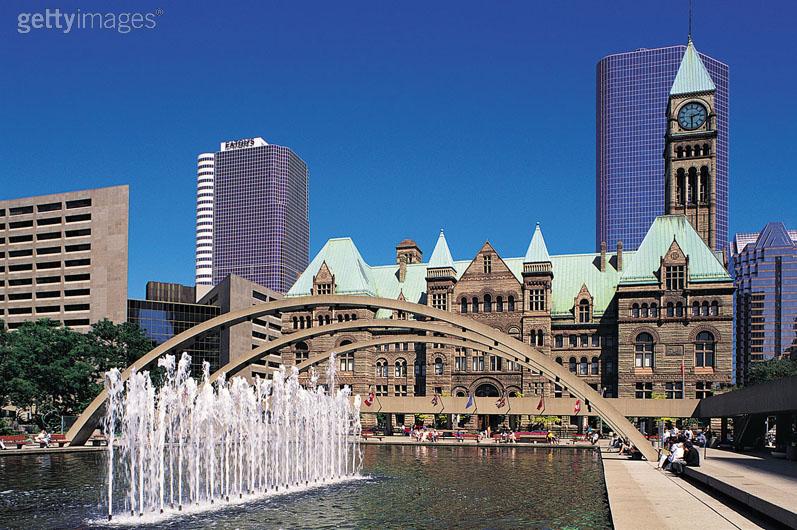
Following Osgoode Hall, we went back across Nathan Phillips Plaza to take a look at Old City Hall. This building is also very distinctive with its grand Romanesque Revival architecture of the late 19th Century. When you see a building like this, all you can do is let out a deep breath and make the banal comment, "Whew, they don't make them like this anymore." Old City Hall, Toronto's third, was built to last. The basement walls are massive at nearly 8 feet thick. You know this monument isn't going anywhere anytime soon, especially thanks to preservation efforts.
We made our way into the Financial District down Bay Street next. First we stopped at the lobby of a 1920s bank in the Canada Permanent Building, which now belongs to the CIBC group. It is a nice example of the Classical Revival Style with some Art Deco touches. Down the street we looked at a pure example of Art Deco--the old floor of the Toronto Stock Exchange. There's not much to see inside except for some of the sleek lines characteristic of Art Deco design. Perhaps the strangest thing about this building is how the urban jungle has grown up around it. The looming, severe black carcass of the Toronto-Dominion Centre now surrounds the diminutive Art Deco building.
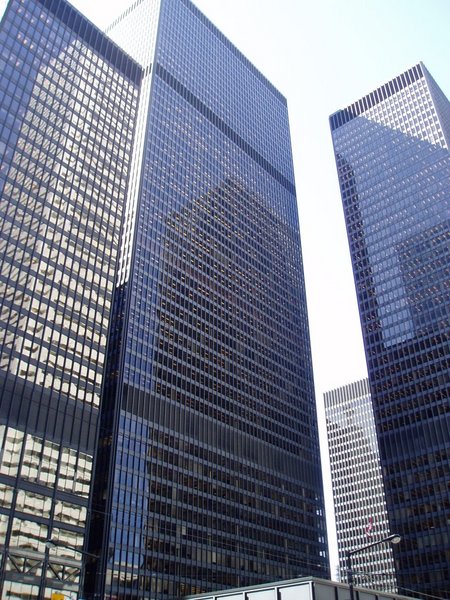
"Looming, severe black carcass" is probably not the right choice of words to describe the Toronto-Dominion Centre, which was by far my favorite building of the weekend. In juxtaposition with the stock exchange, the addition certainly looks imposing, but from other perspectives, the towers are perfect examples of Mies van der Rohe's modernist style. The exteriors of the tower speak for themselves, elegant, distinctive and forceful. The real treat was our tour of the top-floor executive penthouse. It took us an hour to get through the line, but it was well worth the wait. The line extended through the lobby out onto the street. The lobby was austere: empty except for the white marble on the floor and walls and the simple rectangular lines of the window frames. The 54th floor has a similar austerity, but with elements that imbue the sterility with warmth. Imported red oak covers the walls in uniform rectangular panels. The floor is a uniform piece of Italian travertine stone, cut from one vein that stretches 45 meters. Mies designed the furniture himself, which include the Brno Chair, the famous Barcelona chair and his Tugendhat chair. The board room contains a massive 30-foot table made from the same imported red oak.
It is hard to be a defender of modernist architecture these days. To the post-modern eye, it seems boring or cold. In an age when we expect either neo-classical themes and variations or improbable mutations ala Gehry, modernist classics like Mies' towers just don't excite us. Nor do they leave much room for creativity: how many variations of straight lines and rectangles can you have? Nevertheless, standing there in the lobby and again on the 54th Floor, I felt myself transported back in time. I tried to see the building through the eyes of people who would have seen something like this for the first time. There I stood, humbled by how bold and powerful those simple lines are.
Having spent nearly two hours at Toronto-Dominion Centre, Andrey and I rushed to squeeze a few more buildings in before the day ended. We had hoped to tour the Flatiron Building, but there we were met by another long line. We decided that the Flatiron would have to wait until next year. We hurried through one of the many magnificent churches in the Old York part of town. "It's a church like any church," said my ever atheist Andrey. I rather liked the church, because it brought back pleasant childhood memories of elementary school at an Episcopal Church. It even had a familiar smell. But nostalgia didn't merit lingering too long at the expense of seeing some more buildings.
Next on our stop, as we made a circle towards home, was Mackenzie House, which was the home of Toronto's first mayor. It was interesting little stop that showed how people lived in the early 19th Century. There was even a young woman dressed in old clothes trying, with some frustration, to make an almond cake in the wood-burning stove. Convinced that it is much better, though not as quaint, to be living in the 21st Century with microwaves and indoor plumbing, we made our way to our final stop of the day.
St. George's Greek Orthodox Church is visible from our living room window. The members had even arranged for tours every half-hour. Arriving a little bit before the next tour, we went down to the basement. Some old Greek ladies were selling pastries, which they pushed aggressively and convincingly on us. Our whirlwind tour had forced us to skip lunch, so we were happy to have a little snack. One of the Greek grannies said, "You will-uh eat-uh summa spanakopita, no? It is good, no? I-uh made it-uh myself-uh!" Who could argue with that! We scarfed down the spanakopita and bought a baklava for the road.
The tour was actually a thirty-minute lecture that took place in the sanctuary. A young woman provided us with a surprising volume of information about the building and the frescoes. The building was actually an old synagogue--the oldest still standing in Toronto. Holy Blossom Temple, a Reform Jewish congregation, had built the building in 1895. When the congregation outgrew the building, Holy Blossom sold it to the Greek Orthodox community. The building's Byzantine architecture made it ideal for a Greek Orthodox Church. Renovations in the late 1980s brought two monks from Greece to paint new, vivid frescoes. Our lector in great detail took us through the various levels of fresco art, explaining their symbology to us, as well as their significance for church doctrine.
We resumed our tour the next day, although we got a much later start. The first building of the day was actually just a few buildings down from our apartment building. Our stretch of Elm Street is actually quite charming, aside from the monstrous Delta Chelsea Hotel next door. There are quite a few older homes that have been converted to other uses. Most are restaurants, one is a spa, and the one I had always passed and wondered what it was. This last building happened to be open to the public this Sunday and we learned that it housed the Arts and Letters Club of Toronto. The club is one of those terrific institutions that became popular around the turn of the century. Educated men and women, proponents of the liberal arts, met together for fellowship and support. I picture lots of tweed, tumblers with scotch, and old men puffing on pipes, meeting in the evening to recite poetry and discuss that Picasso fellow. The club house has that distinctly Oxford feel (not that I've been to Oxford) that so many North American private schools were modeled upon. Their Great Hall, built in the style of a medieval English inn, so reminded me of both my high school and college that I felt quite at home. And I think it terrific that writers, artists and musicians still gather in such circles--just steps from our building!
From Elm Street we marched over to University Avenue, Toronto's promenade. Our first stop was at the Royal Canadian Military Institute. It's a curious little building which we had passed many times along University Avenue. It looks like a little house, unassuming except for the cannon in front. The name makes you wonder what it might be. Is it a training facility? Is it a strategy think tank for the Canadian armed forces? If so, why is it in such a cute little house rather than on some government compound in Ottawa. It turns out that the Royal Canadian Military Institute is a country club for members of the armed forces and veterans. There's no better description for it, and you certainly can imagine a bunch of grizzled officers sitting around sipping scotch and puffing on cigars. The moment you walk into one of the lounges, your nose wrinkles at the foul smell of stale cigarette smoke.
There is, of course, more to see than the lounge. The club members have put together quite an impressive museum of military artifacts and historical photographs. One room even has the pilot's seat and part of a wing from the Red Baron's famous triplane--the very seat which he perished in during World War I. Portraits are everywhere, and the main dining room has Queen Elizabeth keeping a watchful eye. The library's books are guarded by a portrait of Lord Wellington, just in case Napoleon decides to march up University Avenue. The basement houses an impressive collection of firearms and medals.
From the Royal Canadian Military Institute we had hoped to proceed to the University Club, another diminutive house that serves as a private club for alumni of the University of Toronto. Alas, the club was closed on Sunday. Its doors were open only on Saturday. Next door to the University Club is the United States Consulate. "Maybe they'll let us look around," joked Andrey.
We strolled past the Consulate and continued to the Canada Life building. Built in 1931, it was at one time an imposing structure in Toronto. Architecturally, it is still impressive, and it seems an appropriate addition to University Avenue. The lobby contain significant ornamentation, which is odd, considering that the building was erected at the height of the Great Depression. I guess the insurance business was still pretty good at the time. After watching a rather lame video, we waited in line to take an elevator to the 18th Floor. After the 54th Floor of the Toronto-Dominion Centre tower, the 18th floor doesn't quite leave the same impression. It's always nice to have another view of the city, but Sunday was particularly hazy. We did learn up top, however, that the tower of the Canada Life building is multifunctional. It is a huge weather report. The cycling of the lights (up or down) tells you whether temperatures are rising or falling. The color of beacon on top indicates whether to expect clear weather, cloudy weather, rain or snow. For 1931, that's pretty darn hi-tech. And since the tower is visible from our living room, I will now know that the lights aren't just some random pattern.
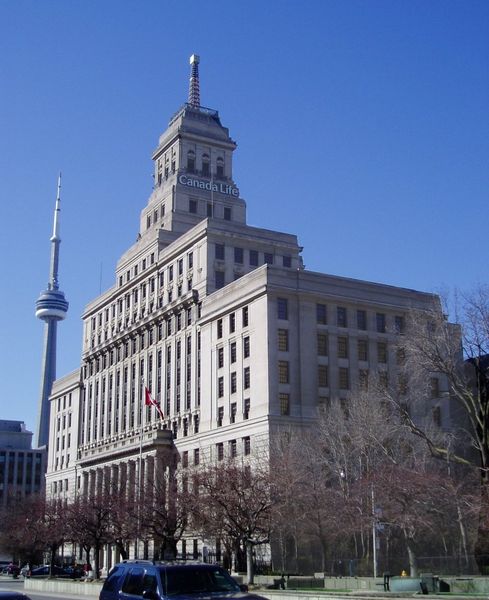
Time was running out. We hurried from the Canada Life building down the street to the Mackenzie House, but there was a line out the door and onto the sidewalk. We'd had enough lines, and buildings were starting to close. We quickly went a few blocks to the Ontario Art Institute, one of the most post-modern buildings in the city. Unfortunately, the doors were locked. They too were only open on Saturday. With our options running out, we decided to go back and stand in line at the Campbell House.
The wait was worth it. Campbell House is one of those historical tourist spots which normally charge a fee for entry. It claims to be the last remaining original brick house in Toronto and was the home of Ontario's Chief Justice. However, when you learn that this is not the original location of the house, it's harder to be as impressed. The house originally sat in the Old Town of York, but a developer in the 1970s wanted to build a parking lot. Concerned citizens banded together to move the house--yes, physically move the house--to its current location. Well, I suppose that's a better alternative that tearing it down, but it's hard to believe that even in the 1970s there was such little concern about historical preservation.
And so, that concluded our busy weekend in downtown Toronto. I'm already exhausted again just from rehashing the whole adventure. Now we will have an entire year to recuperate for next year's Doors Open.
Tags: Toronto, Doors Open, Mies van der Rohe, Toronto-Dominion Centre, Canada Life, City Hall, Old City Hall, Royal Canadian Military Institute, St. George's Greek Orthodox Church, Campbell House, Toronto Stock Exchange, Osgoode Hall
Powered by Qumana
Comments
Thanks for the very interesting tour of my own hometown! Of course, since I'm a native Torontonian, had no clue about any of the history behind those buildings...:-(
It's not much to look at, but you should check out the Russian quarter at Bathurst and Steeles. There, you can find all the Russian food, books and other culture your heart could desire. ^-^
Posted by: Nequila | May 30, 2006 05:43 PM