<?xml version="1.0" encoding="utf-8"?>
<feed xmlns="http://www.w3.org/2005/Atom">
    <title>an ampersand in the Empire of Signs</title>
    <link rel="alternate" type="text/html" href="http://www.ettkin.net/weblog/" />
    <link rel="self" type="application/atom+xml" href="http://www.ettkin.net/weblog/atom.xml" />
   <id>tag:www.ettkin.net,2007:/weblog//1</id>
    <link rel="service.post" type="application/atom+xml" href="http://www.ettkin.net/cgi-bin/mt/mt-atom.cgi/weblog/blog_id=1" title="an ampersand in the Empire of Signs" />
    <updated>2007-02-19T03:05:09Z</updated>
    
    <generator uri="http://www.sixapart.com/movabletype/">Movable Type 3.2</generator>
 
<entry>
    <title>The Oprah Factor</title>
    <link rel="alternate" type="text/html" href="http://www.ettkin.net/weblog/2007/02/the_oprah_factor.html" />
    <link rel="service.edit" type="application/atom+xml" href="http://www.ettkin.net/cgi-bin/mt/mt-atom.cgi/weblog/blog_id=1/entry_id=31" title="The Oprah Factor" />
    <id>tag:www.ettkin.net,2007:/weblog//1.31</id>
    
    <published>2007-02-19T02:42:32Z</published>
    <updated>2007-02-19T03:05:09Z</updated>
    
    <summary> My running joke of late goes, &quot;My God! What will I do if I get a job in an office? I won&apos;t be able to watch Oprah!&quot; My first paycheck will have to go towards a TiVo so I can indulge in Oprah after hours.Over the course of the past year, working from home, I have truly become an...</summary>
    <author>
        <name>Brian Ettkin</name>
        
    </author>
            <category term="Books" />
            <category term="Culture" />
            <category term="Movies" />
            <category term="Reflections" />
    
    <content type="html" xml:lang="en" xml:base="http://www.ettkin.net/weblog/">
        <![CDATA[<p><iframe src="http://rcm.amazon.com/e/cm?t=briapettkanam-20&o=1&p=13&l=st1&mode=dvd&search=Rhonda%20Byrne%20secret&nou=1&fc1=000000&lt1=_blank&lc1=3366FF&bg1=FFFFFF&f=ifr" marginwidth="0" marginheight="0" width="468" height="60" border="0" frameborder="0" style="border:none;" scrolling="no"></iframe><br />
<br>My running joke of late goes, "My God! What will I do if I get a job in an office? I won't be able to watch Oprah!" My first paycheck will have to go towards a TiVo so I can indulge in Oprah after hours.<br /><br />Over the course of the past year, working from home, I have truly become an avid <a href="http://www.oprah.com/"><i>Oprah </i></a>viewer. Previously, I was never a detractor. I admired that she was one of the few remaining talk show hosts who had not sunk to the level of Jerry Springer or Maury Povich. She has managed to find a balance between the occasional sensational story and shows with far more depth. Oprah seems to use her wealth and power for good (and for causes that I support). But, despite my intellectual approval of the Oprah phenomenon, I had not become a fan.<br /><br />A year of sitting at home, struggling to find myself in the Cold White North, has changed how I look at Oprah. After my <i>Starting Over</i> phase and after my self-help book marathon, I have settled into a daily routine of stopping everything, brewing a pot of tea, and watching the Great O from 4:00 to 5:00. There are some shows I skip: learning about bra sizes doesn't really interest me. But others leave me entranced.<br /><br />I can't suspend all skepticism about Oprah. She is a co-marketing machine. Her clout allows her to bring on big stars--conveniently timed for the premieres of their new films or the releases of new albums. Five minutes on Oprah can bring instant success. Any book Oprah mentions for her Book Club instantly rises to the top of the bestseller list. Nutritionists, designers, fitness experts all of a sudden publish bestselling volumes after helping Oprah in her personal struggles. We also have Ms. Winfrey to thank for the rise of Dr. Phil. Her touch is golden indeed.<br /><br />Last week, Oprah did a show on <a href="http://www.thesecret.tv/"><i>The Secret</i></a>, both a DVD and a book about the Law of Attraction and the secret to creating a successful life of wealth and happiness. These ideas were familiar to me from my self-help book depression last year. There is something alluringly appealing to what the proponents of the Law of Attraction have to say. They almost had me ready to buy the video!<br /><br />While watching the show, I went online to see if <a href="http://www.indigo.ca/">Indigo</a>, Canada's book mega-retailer, had the DVD in stock. Indigo's website has a feature that lets you check the inventory of nearby stores. All the stores were well-stocked with over 50 DVDs. Or, I could have ordered the DVD online for delivery within a day. I decided to wait and see. I'm in no position to buy on impulse.<br /><br />After a few days, I thought maybe I would buy it and see what the buzz was all about. I checked online; all nearby stores had sold out. The online store had a delay of two weeks. Amazon was no better. Curious, I ventured to the closest Indigo store (bizarrely called "The World's Biggest Bookstore", though it's hardly that...perhaps Canada's, but not the World's), and they were indeed sold out. I asked the sales associate. He said that they had sold out almost immediately after the airing of the show. Moreover, he told me that they had been informed ahead of time about the show. They were prepared. The Oprah marketing machine was hard at work.<br /><br />Now I'm even less likely to buy the video. Ever the contrarian, I'm not one to jump on bandwagons. Besides, with such sales volume, <i>The Secret</i> would not remain a secret for long. The real secret that interests me is how much of a cut Oprah gets. With one show (plus a subsequent episode the following week), Oprah singlehandedly boosted video and book sales of <i>The Secret</i> probably a thousand-fold. It makes me a bit suspicious.<br /><br />My admiration for Oprah and her success has not diminished. She puts her bounty to good use, and she encourages others to seek success not merely for hedonistic purposes. But I think I'll be a bit more cautious, save thirty bucks, and check out a copy of <i>The Secret</i> from the Toronto Public Library.<br /> <br /><br /><p class="poweredbyperformancing">powered by <a href="http://performancing.com/firefox">performancing firefox</a></p><script type="text/javascript" src="http://www.assoc-amazon.com/s/link-enhancer?tag=briapettkanam-20"><br />
</script><br />
<noscript><br />
    <img src="http://www.assoc-amazon.com/s/noscript?tag=briapettkanam-20" alt="" /><br />
</noscript><br />
</p>]]>
        
    </content>
</entry>
<entry>
    <title>Frontier College: Tackling Canada&apos;s Quiet Crisis</title>
    <link rel="alternate" type="text/html" href="http://www.ettkin.net/weblog/2007/02/frontier_college_tackling_cana.html" />
    <link rel="service.edit" type="application/atom+xml" href="http://www.ettkin.net/cgi-bin/mt/mt-atom.cgi/weblog/blog_id=1/entry_id=30" title="Frontier College: Tackling Canada's Quiet Crisis" />
    <id>tag:www.ettkin.net,2007:/weblog//1.30</id>
    
    <published>2007-02-14T00:22:25Z</published>
    <updated>2007-02-14T00:24:01Z</updated>
    
    <summary>Any parent would be proud to have their child bring home a report card that included an A+ in reading and writing. But what would they think, if after signing off on that stellar mark, they found their child hiding under the bed and struggling to sound out a sentence that kids years younger would have no trouble reading? I&apos;m...</summary>
    <author>
        <name>Brian Ettkin</name>
        
    </author>
            <category term="Canada" />
            <category term="Culture" />
            <category term="Politics" />
            <category term="Reflections" />
    
    <content type="html" xml:lang="en" xml:base="http://www.ettkin.net/weblog/">
        <![CDATA[<p>Any parent would be proud to have their child bring home a report card that included an A+ in reading and writing. But what would they think, if after signing off on that stellar mark, they found their child hiding under the bed and struggling to sound out a sentence that kids years younger would have no trouble reading? I'm not a parent yet, but I would be furious. My anger wouldn't be directed at my child but at the school, at the teacher and at myself? How could there be such a disconnect between the report card and reality?<br /><br />As I learned during a recent visit to <a href="http://www.frontiercollege.ca/">Frontier College</a>, the sad fact is that Canada's report card on literacy doesn't at all match the reality. A surprising 42 percent of adults between the age of 16 and 65 (i.e., the labor pool) does not possess the minimum literacy skills for coping with everyday life and work. I think many Canadians would join me, a newcomer to Canada, in expressing disbelief. How is it that one of the most advanced nations in the world could suffer from such low literacy rates?<br /><br />Many of my compatriots south of the border tend to idealize Canada as a more equitable social democracy. Officially, Canada's literacy rate is 99 percent of the population over 15. On the United Nation's Human Development Index, Canada ranks 6th, ahead of Japan, the United States and Switzerland. These impressive scores bolster the impression of Canada as a progressive haven.<br /><br />The devil is in the details, I suppose, or in this case, in the statistics. An indicator is only as useful as its definition. Comparing indicators only makes sense if we know that we are comparing apples to apples. Clearly, Statistics Canada uses a low threshold for measuring the ability to read and write. The figure given to me by Frontier College comes from the International Adult Literacy Survey, which decomposes "literacy" into five levels. The first two levels, which comprise the 42 percent, represent a very low level of functional literacy. Clearly, only knowing one's ABCs isn't enough for most contemporary jobs or even for day-to-day tasks that the rest of us take for granted, like writing a check or finding a doctor's office. (To the credit of Statistics Canada, all of this information is freely available on their <a href="http://cansim2.statcan.ca/cgi-win/cnsmcgi.pgm?Lang=E&amp;ResultTemplate=Srch3&amp;CORCmd=GetTCount&amp;CORId=2549">website</a>, and they are evidently tracking literacy trends with concern.)<br /><br />Identifying an issue like low literacy rates and advancing it onto the political agenda are two very different problems. Frontier College Executive Director Cathy Mann posits that one reason for this "quiet crisis" is the stigma attached to being illiterate. The people who suffer most from this problem are unlikely to speak up for fear of being identified as illiterate. And if they don't speak for themselves, who will speak for them? In many cases, even their own loved ones are unaware of the problem. And so the problem continues unrecognized. Compound upon this silence the facts that illiteracy and poverty are positively correlated and that being illiterate makes political participation such as voting difficult, then it is easy to see just how politically and socially disenfranchised many people with literacy problems are.<br /><br />Organizations like Frontier College continue to provide services for Canadians with literacy problems. Thus, they try to address the problem one person at a time. But no one organization can singlehandedly solve a problem that affects 9 million Canadians. This issue should be elevated to the level of national crisis, like global climate change and terrorism. <br /><br />As an American in Canada, I'm aghast that such a supposedly progressive country could allow this problem to continue unheeded. From my own experience working in international development, I know that literacy is tied to economic development. It's also an important social equalizer that helps ensure the stability of democratic institutions. In a globalized economy, advanced countries need to be moving farther along the curve in terms of skills development to maintain their competitive advantage.<br /><br />Is Canada slipping behind? Between 1992 and 2000, it held the top spot in the Human Development Index. It seems to have been dropping ever since. I'm not one for gloom and doom, so I'll give the Canucks the benefit of the doubt. Surely they will get their act together. Surely they won't go the way of my native land, spurning social equity in the name of ideology or political expedience.<br /><br />In the meantime, it's nice to know that there are groups like Frontier College giving voice to the voiceless and helping them make the grade for real.<br /><br /><br /><p class="poweredbyperformancing">powered by <a href="http://performancing.com/firefox">performancing firefox</a></p></p>]]>
        
    </content>
</entry>
<entry>
    <title>2007: Three Weeks In</title>
    <link rel="alternate" type="text/html" href="http://www.ettkin.net/weblog/2007/01/2007_three_weeks_in.html" />
    <link rel="service.edit" type="application/atom+xml" href="http://www.ettkin.net/cgi-bin/mt/mt-atom.cgi/weblog/blog_id=1/entry_id=29" title="2007: Three Weeks In" />
    <id>tag:www.ettkin.net,2007:/weblog//1.29</id>
    
    <published>2007-01-22T03:18:27Z</published>
    <updated>2007-01-22T03:22:20Z</updated>
    
    <summary>New Years bring more of a social purpose than a temporal one. The universe will continue to operate, the planets will continue to orbit the sun, and the tides will continue to wash away the shore whether we humans celebrate the New Year or not. December 31 flows seamlessly into January 1. These are just made-up days of a made-up...</summary>
    <author>
        <name>Brian Ettkin</name>
        
    </author>
            <category term="Personal Updates" />
            <category term="Reflections" />
    
    <content type="html" xml:lang="en" xml:base="http://www.ettkin.net/weblog/">
        <![CDATA[<p>New Years bring more of a social purpose than a temporal one. The universe will continue to operate, the planets will continue to orbit the sun, and the tides will continue to wash away the shore whether we humans celebrate the New Year or not. December 31 flows seamlessly into January 1. These are just made-up days of a made-up calendar imposed upon the cycle of night-and-day, of winter-to-spring in order provide some sense to the world we live in.</p>
<p>But the ultimate banality of seasons does not prevent us from imbuing the passage of one year with significance. The New Year is a time for new starts; it is a time when we &quot;reboot our system&quot; as it were. That doesn't mean we erase the past, but we try to take into account the challenges of the previous year so that we may make the most of the 365 days to come.</p>
<p>For me, it was a welcome change. Two thousand six was an ambivalent year for me. It had its ups--such as finally being reunited with Andrey and having the opportunity to build a life with him. Most of the year, however, was an anxious one, spent in a state of unpleasant ambiguity.</p>
<p>Ambiguity came from starting from scratch in a new city--again. Since living Chattanooga after high school, I have not lived in the same place for more than three years. In the past seven years, I have lived in six different places (Artyom, Vladivostok, Chattanooga, Monterey, Chattanooga, Toronto). At some point, one just wants to put down roots, and Toronto has been a rather difficult place for us to find a sense of community.</p>
<p>The major down, as most will know, was my inability to secure employment in Toronto in 2006. This challenge came as a surprise to many--a bright, trilingual person with international experience and two master's degrees can't find work in a cosmopolitan financial center. Believe me, it was equally frustrating for me. I reached several emotional lows, and by the end of 2006, I was ready to throw in the towel on Toronto and Canada.</p>
<p>Luckily, that was exactly the time when we left Canada to spend the holidays in Tennessee. Sometimes you just gotta get out of your head, and the only way to do that is get out of  your seat. Having the three weeks in Chattanooga took off some of the pressure and anxiety.</p>
<p>Three weeks, a lot of thought and many useful conversations with long-time friends and mentors later, we returned to Toronto, and I came up with a new plan for 2007--to reboot myself and get my life on track.</p>
<p>One of my first realizations was that I was not being true to myself. I had sold myself a story: just get a job in business, any job. It will be good experience, good training, good money. Moreover, since there would be few policy-related positions available in Canada, it made more sense to focus on the private sector. There was a certain logic to the story, and I tried hard to make it my story.</p>
<p>&quot;The heart has its reasons that we know not of,&quot; wrote Pascal. And the sentiment continues that, all too often, reason alone has no heart. My heart was not accepting the logic of this story, primarily because it was contrary to all the choices I had made over the previous ten years. And those choices were not made lightly. They were based on the priorities I had set for myself after significant contemplation and self-reflection. All of a sudden, I was abandoning my passions, as well as the accumulated experience and training of three years in Peace Corps and three years in graduate school. All of this was in the name of putative pragmatism. It seemed the reasonable, logical thing to do.</p>
<p>But a round peg does not fit into a square hole, and I need to be doing the things that I went to graduate school to do. Because Canada has so little to offer me professionally, this means making a strategic change in either geography or outlook. Geographically, the most logical place for me to be is Washington, D.C. That is where the jobs are for people with my interests, whether that be in government, at a think tank, or with a non-governmental organization. More importantly, I have a well-established network of friends, as well as family, who live in D.C. Nevertheless, I am not anxious to leave Toronto--that is, to leave Andrey again.</p>
<p>Attitudinally, I need to look at my current situation and figure out how I can get back in the game. After spending one year in Toronto, my knowledge of my field has depreciated somewhat. Now is the time for me to build back up my familiarity of current events--which change so quickly these days. Furthermore, I must really make an effort to build up my credibility: through research, through writing and through participation in meaningful, public projects.</p>
<p>At the same time, we still have financial realities, especially after the winter holidays. Therefore, I will continue to do international marketing and business consulting for ANZU Technology in California. We have built up a positive working relationship over the past eight months. They seem to be satisfied with my work. After the new year, we renegotiated the terms of my work for ANZU, which make me happier to continue the relationship. The critical point here is that working part-time for ANZU will allow me the time to pursue my first goal of getting back in the Russia field. While continuing to grow as a business professional, I will also have the time and financial resources to stay engaged in international policy issues.</p>
<p>So that's where I am, three weeks into the New Year. I've rebooted my system so that I can look at the same situation from a different perspective. It's an ambitious resolution, but I think it's doable. Now I just have to lose thirty pounds, exercise regularly, brush up on my Japanese, correspond more regularly with dear friends, eat more healthily, read more literature, go to the opera, take in an art exhibit, and darn my socks. Then 2007 will truly be a great New Year.</p>
<p style="color:#008;text-align:right;"><small><em>Powered by</em> <a href="http://www.qumana.com/">Qumana</a></small></p>
]]>
        
    </content>
</entry>
<entry>
    <title>Stranger than Fiction</title>
    <link rel="alternate" type="text/html" href="http://www.ettkin.net/weblog/2007/01/stranger_than_fiction.html" />
    <link rel="service.edit" type="application/atom+xml" href="http://www.ettkin.net/cgi-bin/mt/mt-atom.cgi/weblog/blog_id=1/entry_id=28" title="Stranger than Fiction" />
    <id>tag:www.ettkin.net,2007:/weblog//1.28</id>
    
    <published>2007-01-21T06:02:56Z</published>
    <updated>2007-01-21T06:10:51Z</updated>
    
    <summary><![CDATA[ When you're an armchair philosopher, it's hard not to like a movie like Stranger than Fiction. Similar to I Heart Huckabee's in its quirky tone, this film, starring Will Ferrell and Emma Thompson, brings an existential sort of playfulness that we &quot;artsy&quot; movie-goers like. Sartre would probably object to the use of &quot;existential&quot; and &quot;playful&quot; in the same sentence,...]]></summary>
    <author>
        <name>Brian Ettkin</name>
        
    </author>
            <category term="Culture" />
            <category term="Movies" />
            <category term="Reflections" />
    
    <content type="html" xml:lang="en" xml:base="http://www.ettkin.net/weblog/">
        <![CDATA[<iframe src="http://rcm.amazon.com/e/cm?t=briapettkanam-20&o=1&p=8&l=as1&asins=B000LXH0AE&fc1=000000&IS1=1&lt1=_blank&lc1=0000FF&bc1=000000&bg1=FFFFFF&f=ifr" style="width:120px;height:240px;" scrolling="no" marginwidth="0" marginheight="0" frameborder="0"></iframe>
<p>When you're an armchair philosopher, it's hard not to like a movie like <em>Stranger than Fiction</em>. Similar to <em>I Heart Huckabee's</em> in its quirky tone, this film, starring Will Ferrell and Emma Thompson, brings an existential sort of playfulness that we &quot;artsy&quot; movie-goers like. Sartre would probably object to the use of &quot;existential&quot; and &quot;playful&quot; in the same sentence, but seeing as how he died just as postmodernism was surpassing existentialism as the sexy philosophical trend of the day, he--or his decomposed corpse--will have to make peace with the irony. I'm not in the habit of apologizing to dead French philosophers, in any case, for liking a movie like this one.</p>
<p><em>Stranger than Fiction</em> tells the story of an exceedingly boring IRS agent, played by Ferrell. His life fits every stereotype of a government bean-counter--a meaningless routine of protocol and precision. Harold's dreary existence is interrupted one morning when, while methodically brushing his teeth, he hear's a woman's voice. This woman, who speaks with an enchanting British accent,  not only recounts the process of Harold's life in perfect detail but also tells of his inner thoughts. At first, Harold thinks himself crazy, but soon he understands that he is the character in a story. The voice is that of his narrator.</p>
<p>The inimitable Emma Thompson plays the neurotic writer who must finish her next novel, of which Harold is the main character. Composing the appropriate conclusion to the novel is driving her crazy. A severe case of writer's block prevents her from finding the right ending to the story--which must involve Harold's own end. And this is where the existential tragicomedy takes off. Here I shall not spoil the rest of the movie, but leave it to you.</p>
<p>It's a clever film, well written and superbly directed. A stellar cast bolsters it further, including Maggie Gyllenhall as Harold's love interest, an archetypal foil to the by-the-book IRS auditor. Dustin Hoffman proves that literature professors do have value in life. He plays a scholar of literary theory who comes to Harold's aid--providing more guidance than any psychologist could. This role is oddly quite similar to the one Hoffman played in <em>I Heart Huckabee's</em> as the existential detective. But he plays it well. Thompson is, well, Thompson. She is one of the finest actors alive, and her performance in this movie once again demonstrates her mastery of nuance and minute details.</p>
<p>The biggest surprise is Will Ferrell's performance. I am no fan of Will Ferrell's, and I consider the time I spent watching <em>Anchorman</em> to be one of the greatest wastes of my life. It is hard not to be skeptical of actors who come from the school  of stupid humor when they try to crossover to more serious roles. Jim Carrey pulled it off in <em>The Truman Show, </em>but not all of his subsequent attempts have been as convincing. Adam Sandler's <em>Punch-Drunk Love</em> was a pitiful attempt to follow in Carrey's footsteps, and I'm amazed that it got as much positive buzz as it did. </p>
<p>Typically, actors like Ferrell, Carrey and Sandler are unable to tone it down. They are accustomed to playing over-the-top characters in films whose humor depends on blatant and boorish gags. More sophisticated comedies require them not to force themselves beyond the bounds of the character they are playing. Whereas Ferrell seemed entirely incapable of pulling subtlety off in <em>Bewitched</em> (oh, poor Nicole Kidman!), in <em>Stranger than Fiction</em> he strikes exactly the right balance. Ferrell eschews outlandishness, even at moments where you expect him to give into the temptation. Throughout the movie, he keeps it under control. Instead of Will Ferrell trying to be funny, we get to see the underlying humor that is inherent in the story. But that humor can only emerge through the restraint of the actors. In turn, restraint yields irony, which is the outcome of this man's absurdly, boring life.</p>
<p>A friend of mine, who is a retired philosophy professor, couldn't stand <em>I Heart Huckabee's.</em> His reaction surprised me at first, but I suppose if you are a philosophy professor, watching Hollywood muck up the intricacies of existential thought might be painful--just like real doctors cringe when watching medical dramas like <em>E.R.</em> or <em>Grey's Anatomy</em>. Moreover, there is now something rather unoriginal about movies trying to be so original. Really, we've seen it all before: <em>The Truman Show,</em> <em>Eternal Sunshine of the Spotless Mind, I Heart Huckabee's, Stranger than Fiction</em>. All these films plays with our ontological presuppositions and challenge us to reexamine our perceptions of life, and the moral tends to be more or less the same--and far more saccharine than anything Sartre or Camus would have written. </p>
<p>But just as armchair doctors like medical dramas, armchair legal eagles like courtroom dramas, and armchair spies like a good espionage drama, we armchair philosophers will probably continue to gobble up existential comedies like <em>Stranger than Fiction. </em>If I wake up to have Emma Thompson narrating my life, I certainly won't mind.</p>
<p style="color:#008;text-align:right;"><small><em>Powered by</em> <a href="http://www.qumana.com/">Qumana</a></small></p>
]]>
        
    </content>
</entry>
<entry>
    <title>Rendezvous Detroit</title>
    <link rel="alternate" type="text/html" href="http://www.ettkin.net/weblog/2006/12/rendezvous_detroit.html" />
    <link rel="service.edit" type="application/atom+xml" href="http://www.ettkin.net/cgi-bin/mt/mt-atom.cgi/weblog/blog_id=1/entry_id=27" title="Rendezvous Detroit" />
    <id>tag:www.ettkin.net,2006:/weblog//1.27</id>
    
    <published>2006-12-04T16:22:23Z</published>
    <updated>2006-12-04T16:42:11Z</updated>
    
    <summary> Over seven years had passed since I had seen my friend Melanie. The years had taken us along varied paths and to distant corners. My fate sent me to Japan, then Russia. Melanie had blazed a trail to Dubai. Over the years of criss-crossing the globe, our paths never crossed and we never met. E-mail allowed for infrequent correspondence,...</summary>
    <author>
        <name>Brian Ettkin</name>
        
    </author>
            <category term="Culture" />
            <category term="Reflections" />
    
    <content type="html" xml:lang="en" xml:base="http://www.ettkin.net/weblog/">
        <![CDATA[<iframe src="http://rcm.amazon.com/e/cm?t=briapettkanam-20&o=1&p=13&l=st1&mode=books&search=detroit&fc1=&lt1=&lc1=&bg1=&f=ifr" marginwidth="0" marginheight="0" width="468" height="60" border="0" frameborder="0" style="border:none;" scrolling="no"></iframe>
<p>Over seven years had passed since I had seen my friend Melanie. The years had taken us along varied paths and to distant corners. My fate sent me to Japan, then Russia. Melanie had blazed a trail to Dubai. Over the years of criss-crossing the globe, our paths never crossed and we never met. E-mail allowed for infrequent correspondence, but it wasn't until my &quot;exile&quot; to Canada that we began to rekindle the friendship in earnest.</p>
<p>October brought an e-mail: &quot;I'll be in Detroit in December. Can you meet me?&quot; This would be the closest we had been to one another in more than seven years. Of course, I would meet her. Considering my current employment situation, it would be no problem to make the short jaunt from Toronto to Detroit.</p>
<p>Originally, we planned to rendezvous in Windsor for dinner. As the time came closer--and I procrastinated more--our plan evolved. Driving turned to taking the train, and dinner to twenty-four hours of marathon catching up, with me staying the night in Melanie's hotel room. If the circumstances were different--if Melanie were single (or not) and if I were a single (or not) straight man--our meeting might have the spicy flavor of a torrid, rekindled affair. The final change in the plan was to move the meeting from Windsor, across the river, to Detroit. That alone would've taken the fire out of the romance.</p>
<p align="center">* * * * *</p>
<p>My first impression of Detroit was a brief and uninspired one. I took a wrong turn while driving back from Chicago to Toronto with Andrey. Trying to find the bridge to Canada, we had the opportunity to explore various back streets of Detroit. These types of misadventures do not endear a city like Detroit to you. After getting back to Toronto, I wrote to my friend Ejiro, originally of Detroit, about my disenchantment with her hometown. She promptly scolded me and told me that that's no way to judge Motor City USA. I was more than happy to grant her this point, and Detroit remained on my list of places to explore further (though not very high on the list).</p>
<p>It would be great to say that my second, longer trip to Detroit erased my previous impression of the city. But the there's no point in wasting any ink on a lie. Another twenty-four hours in Detroit only cemented what I felt the first time: Detroit is a dismal, depressing, dreary dump. Pardon my alliteration.</p>
<p>Downtown Detroit is dead. Even Cleveland, Ohio, where we were in September, has more going on. The concierge at the hotel sent Melanie and me on our way to the Detroit Institute of Arts, a promising first stop--if only our taxi driver could find it, and here I must digress about Detroit taxi drivers. Perhaps it was our bad luck, but all the taxi drivers we encountered in Detroit were either odd, frightening, or both. Contestant Number One had no idea where the Detroit Institute of Art was--an odd predicament for a cab driver to be in. Luckily, Melanie had grabbed a brochure for the museum, and we gave it to the driver. He more or less got us to the general vicinity, but we had to circle the building two more times (and point it out to him ourselves) before we got there.</p>
<p>The Detroit Institute of Arts is in that old style of museums, like in Cleveland or Chicago. It was probably built with money from robber barons or auto industry tycoons, and the imposing style is that Beaux-Arts design popular in the 1920s. It's a grand, ominous gray building, but I liked it in a way. It's the type of building that makes you say, &quot;They sure don't build them like this anymore.&quot;</p>
<p>As luck would have it, the special exhibit was an extensive collection of photographs by Annie Liebowitz. The uniting theme was American Music--rather appropriate for a photographer who has taken many pictures over the years for Rolling Stones. In fact, I already owned the catalog to the exhibit. My mother had given it to me for the holidays a couple of years ago, so I assume that the traveling exhibit was making its way through the second-tier cities.</p>
<p>Before hitting Annie's work, we made our way through the permanent collection. The DIA apparently has too many art history Ph.D.s on its staff, because the collection was exhibited in one of the strangest hodgepodges I had ever seen. Somebody had come up with the idea of &quot;Remix,&quot; perhaps in a drunken stupor at last year's Institute Christmas fundraiser where the DJ was remixing Tony Bennett with ambient synthesizer music. Here &quot;remix&quot; seemed to imply combining familiar works in unconventional ways in order to startle us into new modes of viewing. They might as well have put the names of all their works in a hat and drawn them at random for each gallery.</p>
<p>Some pieces were organized according to rather conventional themes, such as Art and Spirituality. This was a rather meager attempt at being politically correct, since &quot;spirituality&quot; was nonetheless quite traditionally religious. One gallery had a large assortment of Mary and Child paintings. This  reminded me of the Vatican Museum, which has a nauseatingly endless number of rooms dedicated to variations on the Virgin and Bambini theme. Alas, Detroit is not Rome, and the DIA doesn't have the same devilishly handsome security guards dressed in Armani suits.</p>
<p>Spirituality became geographic when we entered the &quot;East Asia&quot; room, a paltry collection of paintings and objects, some nice, others average, and some garish. Though they tried to keep them Chinese separate from them Japanese, there was a rather confusing display that showed a large Japanese tea jar next to a small tea bowl. Unfortunately, an unwitting visitor might have assumed that the tea bowl was part of the set if they hadn't taken the time to read a tag on the other side of the glass that informed the visitor that the glazed bowl was in fact Chinese. Chinese, Japanese, what's the difference. The Koreans also got they're own little pedestal, although it's not entirely clear why the pieces went together, except for coming from a land mass that currently is under Korean sovereignty (North or South, who cares?).</p>
<p>If the East Asia room offended my sensibilities, Melanie, who was a history major, who has traveled extensively through the Middle East, and who now lives in Dubai, was appalled at the Islam room. It was even more a mish-mosh than the East Asia room. There was indeed a lovely Quran, but there was also a tile with an inscription that had been cut off. Oh well, who would mind if some archeologists in the future displayed a plaque that said &quot;Raise Jes&quot; instead of &quot;Praise Jesus&quot;?</p>
<p>There's no need to go through the whole collection. Suffice it to say, that the matchings became stranger and stranger. One gallery was dedicated to the animal world, and the objects ranged from grandfather clocks to sculptures to renaissance paintings to abstract expressionists. Another hall contained &quot;everyday objects,&quot; including an Eames bench underneath a classical painting, with an electric plug suspended from the ceiling. Even Michael Graves had a piece of furniture there from before his Target years. How bizarre it all was! Has the State of Michigan made an exemption to marijuana use for museum curators?</p>
<p>The Annie Liebowitz exhibit was nice, although a bit too much. Every photograph had commentary from Annie, which you had to listen to through a heavy mace like handset. Each picture had a number which you dialed in. By the end, my right bicep was larger than my left, and I no longer cared why Annie decided to shoot a picture of Beck in his old Lincoln.</p>
<p>The DIA is not in a part of town that gives you a sense of feeling safe. Actually, there may be no such neighborhood in Detroit. Between our hotel along the river and the museum, we saw rows of abandoned houses and projects. The entire stretch, which we saw more than we expected of thanks to our clueless first cabbie, was desolate, with the exception of Wayne State University. The University seems to be the only institution in the city that isn't in decay. (Disclosure: The President of Wayne State University is a family friend.) Leaving the DIA, we saw nothing else in the area that we wanted to explore, especially with nightfall approaching. We decided to do the American thing and shop.</p>
<p align="center">* * * * *</p>
<p>Melanie called the hotel to find out where the nearest shopping area was. Apparently, if you want to grease the wheels of commerce, you have to do so outside the Detroit city limits. The closest place was in the nearby suburb of Dearborn. Sigh, we would need another taxi.</p>
<p>We began walking down the street in the hopes of finding a taxi. This was probably not a smart decision--as we realized passing some shady characters. When we were about to give up and try to call a cab company, I saw one in the distance. We walked towards it and tried to flag it down. Along came Contestant #2 in our taxi misadventures.</p>
<p>The cab driver was a bit suspicious of us at first. Apparently, we were standing in front of the police precinct when he picked us up. We assured him that we were not coming out of the precinct. We sped on our way towards the shopping mall, running over the curb as he turned the corner--quite a feat since he was turning into the middle lane. For some reason, he chose not to pick up the pace as we drove past more housing projects. He explained that the police like to setup speed traps on this stretch of rode. We saw no police. It would have been nice if we had.</p>
<p>Most Detroit taxi drivers are more talkative than I'm used to. He asked where I was from, and I told him that I currently lived in Toronto. Everyone seems to have visited Toronto, but not recently, but it's a nice city, how do you like the winter. Taxi Driver #2 asked me if I knew the OPP. Melanie looked at me, since she only new the old song &quot;You down with O.P.P.?&quot; I said that I did know of the Ontario Provincial Police. He asked if the OPP were in Toronto. I said yes. He seemed surprised and asked why the O.P.P. were in Toronto. I explained that Toronto is in the Province of Ontario, where the O.P.P. work. I then began to wonder if he at some point had had cause to meet O.P.P. agents. Then he asked about the Mounties, and I surely hoped he had not met a Mounty.</p>
<p>&quot;You ever meet Dudley Dooright?&quot; he asked me.</p>
<p>&quot;No, sir. He's never come to my door, and I hope he never does,&quot; I replied, thinking myself witty.</p>
<p>&quot;Well I do believe that Dudley Dooright is a fictional character you see.&quot;</p>
<p>&quot;Umm, yes, sir. He is indeed a fictional character.&quot;</p>
<p>I looked over, and Melanie was trying very hard not to laugh.</p>
<p>At that point, our taxi driver got on his cell phone and started telling his sister that she needs to eat more. We finally made it to the mall in Dearborn, and he dropped us off at Sears.</p>
<p>&quot;We're not having very good luck with taxis,&quot; said Melanie.</p>
<p align="center">* * * * *</p>
<p>The shopping mall in Dearborn is a bizarre place. Okay, all shopping malls are bizarre in terms of sociological diversity. But this one was particularly strange. The architects seemed to have completed the same graduate program as the curators of the DIA, because the mall was laid out in a way that made absolutely no sense. It has two-and-a-half levels, but it's not entirely clear how these levels are connected. There are ramps and stairs that go all over the place, and if you want to go from the first floor to the second floor, you have to hope that the ramps will take you where you want to go. You might get stuck on the half level in between, or you might go up half-way only to find your ramp descending again. Some ramps only went down part of the way before hitting a set of stairs. I'm not quite sure how people in wheelchairs were supposed to get around. We had enough trouble trying to figure out where we wanted to go.</p>
<p>Indeed, if you want a slice of life in a town, go to the mall, because there's always such a mix of people. The whole hip-hop culture of wearing pants at your thighs still makes no sense to me, especially when it's a six-year old kid clearly dress by his mother, who is wearing a miniskirt with no tights or hose in below-freezing weather. The Lebanese families were out in full force, doing their Christmas shopping in their head coverings. I guess a sale is a sale, Allah be Praised. The Starbucks had misspelled Christmas in their &quot;Chrismas Blend&quot; sign, to which Melanie said, &quot;At least they wrote Pumpkin Spice Eggnog' in Arabic.&quot; I took her word that the scribble at the top said just that.</p>
<p align="center">* * * * *</p>
<p>When we had had our fill of the various mall subcultures, we went to the exit and called a cab. Here we met Candidate #3 in the Mad, Mad Cab contest. He was another talker, but he was a bit more articulate than the previous two drivers. Here the contest came down to content, not just form.</p>
<p>Strangers seem to like to share their life story, and we learned about his days as a truck driver. He had been to Toronto, but it had been a while, but it's a nice city, but don't go there with a woman, because a woman will spend all your money and leave you with nothin', but Toronto's a nice city even though he hadn't been there in a while.</p>
<p>Somehow, our conversation took a political turn, beginning with the execution of all the Enron executives. Then we began talking about Saddam Hussein.</p>
<p>&quot;He's smart. Too smart for all them lawyers. He's a master chess player, yes sir, and he's gonna get out of it, you just watch. They don't know what they're in for.&quot;</p>
<p>&quot;You think they won't execute him.&quot;</p>
<p>&quot;No, man. He's too smart. Like a master chess player. That don't mean that I like him. I'm just saying, you gotta recognize intelligence when you see it. And he's smart. Like Johnny Cochrane.&quot;</p>
<p>&quot;Excuse me?&quot;</p>
<p>&quot;You know, a good defense, like Johnny Cochrane.&quot;</p>
<p>&quot;You mean the glove?&quot;</p>
<p>&quot;That's right! 'If the glove don't fit, you must acquit.' And the glove don't fit!&quot;</p>
<p>I looked at Melanie. She looked at me. Neither of us was sure what glove he was talking about, but there was no point in telling him that Melanie lives in the Middle East and I have a graduate degree in international policy.</p>
<p>The conversation turned to the Detroit economy. He was vague about whether he thought things were getting better, but he said that the Tigers playing in the playoffs was good for the city's economy. Then he gave us the rest of his analysis of Detroit's sporting economy. Finally, he told us about the attempt to make Detroit like New York.</p>
<p>&quot;Yeah, man. They're trying to make an entertainment district like in parts of New York City. A little slice of New York. That's what I'm saying. You know, it looks a bit like New York.&quot;</p>
<p>He neglected to say which slice of New York City Detroit looked like. But we had made it back to our hotel.</p>
<p>&quot;No more taxis in Detroit,&quot; declared Melanie.</p>
<p align="center">* * * * *</p>
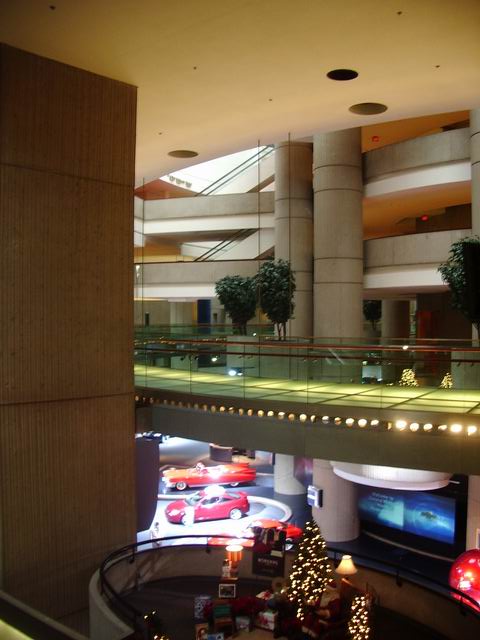
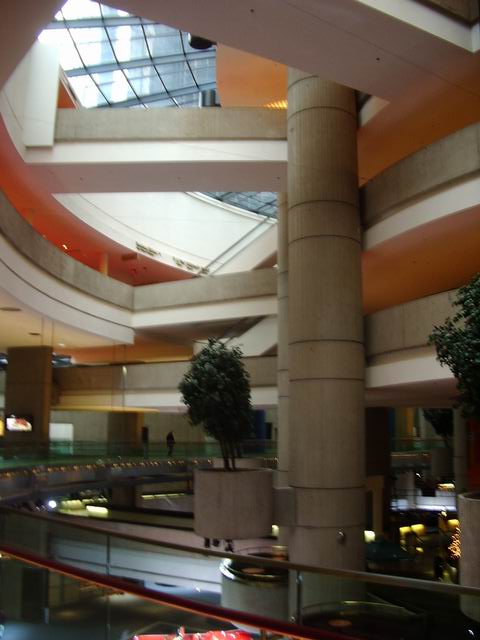
<p>Our hotel was as bizarre as the Dearborn mall. It's like a science fiction nightmare, a labyrinth from which there is no escape. That Renaissance Center doubles as the General Motors worldwide headquarters is a sad metaphor for the state of the world's largest automaker. It's a confusing mess that might have looked good on paper, but got screwed up in the execution.</p>
<p><img height="326" style="margin:5px;" width="243" alt="" title="Renaissance Center: The Circulation Ring of Fire" src="http://www.ettkin.net/weblog/2006-12-04%20130.JPG" /><img height="315" style="margin:5px;" width="236" alt="" title="Renaissance Center: View from the Circulation Ring of Fire" src="http://www.ettkin.net/weblog/2006-12-04%20131.JPG" /></p>
<p>Like the shopping mall, the interior is a confusing maze of ramps and escalators. It's organized around various rings, which may have seemed cool to the architect, perhaps a Dante or Wagner fan, but left me hoping he would spend an eternity in hell going in circles. The main ring is called the &quot;circulation ring.&quot; Essentially, you go around and around in circles until you figure out which way you need to turn to go where you want to go. The lobby to the hotel is not on the first floor, but on the third. The first is not the first. The elevator from the first to the third is not the one to your room. And you can't get to one set of elevators directly from the other. If you enter the building from another side, you must navigate various rings and levels and escalators to get to the circulation ring, and then figure out how to get from there to the main elevator core, which is in turn divided into two sets of elevators: those going to floors 9 through 40 and those going from floors 40 through 70. Melanie and I spent many hours trying to get off the damn circulation ring.</p>
<p>The confusing design of the Renaissance Marriott is somewhat mitigated by its staff. These are some of the nicest hotel staff I've ever met. Every person was extremely helpful. Each employee was friendly, and we were greeted with hellos and welcomes from everyone we met, down to the janitors. The restaurant staff were also friendly and accommodating. It would be great if this were the standard for all Marriott hotels.</p>
<p>For dinner, we decided not to venture beyond the orbit of the hotel. We went to a restaurant inside the Renaissance Center called Seldom Blues. The hostess was nice enough to squeeze us in without a reservation. The restaurant has live music, and a nice, very upscale menu. Apparently, Seldom Blues is one of Detroit's happening places. The food and the service were quite good, although a bit pricey by my standards. The first performer was a jazz pianist who played a bunch of standards. She was an older black woman, completely decked out with an elegant black dress and a large and bizarre headpiece. If only she were a drag queen, the show would have been complete. She was followed by a jazz band led by Randy Scott. It was a very talented group. Randy plays a variety of saxophones. We enjoyed the show and the dinner.</p>
<p align="center">* * * * *</p>
<p>Our second day in Detroit proved more of a disaster. After a nice breakfast buffet in the hotel, we went to the concierge for more suggestions.</p>
<p>&quot;Have you tried the Detroit Institute of Arts?&quot;</p>
<p>&quot;Yeah, we did that yesterday.&quot;</p>
<p>&quot;Ah. Ya'll done and gone done it all, then.&quot;</p>
<p>&quot;What about the Motown Museum?&quot;</p>
<p>&quot;It's closed on Sunday.&quot;</p>
<p>&quot;Oh.&quot;</p>
<p>&quot;Maybe you want to go bowling?&quot;</p>
<p>&quot;I don't think so.&quot;</p>
<p>&quot;I'm trying to think what I'd want to do. How about ice skating?&quot;</p>
<p>&quot;Probably not.&quot;</p>
<p>&quot;Play pool?&quot;</p>
<p>&quot;Not really.&quot;</p>
<p>&quot;Hmm.&quot;</p>
<p>&quot;Is there anywhere to do some shopping downtown?&quot;</p>
<p>&quot;Naw. It's all closed on Sunday.&quot;</p>
<p>&quot;I see.&quot;</p>
<p>&quot;Sorry.&quot;</p>
<p>Melanie and I looked at each other. We decided to take a ride on the People Mover, an elevated train that makes a loop around downtown Detroit. Alas, the People Mover didn't open until noon on Sundays.</p>
<p>Melanie wanted to get a prescription filled, so we went back to the concierge.</p>
<p>&quot;Well, you'll probably have to take a taxi, because the CVS near here is closed on Sundays. It's about a five minute cab ride.&quot;</p>
<p>Since we had nothing better to do, we figured we'd walk to the pharmacy. A five minute cab ride should be about a twenty minute walk, and after last night's dinner and this morning's breakfast, we needed to walk a bit.</p>
<p>In retrospect, taking a Sunday stroll around downtown Detroit was not the best of ideas. One block away from the Renaissance Center, and things went downhill quickly. We headed east on Jefferson Avenue. The further we went, the worse the surroundings got. There were more abandoned and derelict buildings. Not many cars passed by. Other pedestrians were definitely &quot;salt of the earth.&quot; It was a cold morning, and the CVS seemed quite a bit further than twenty minutes walking. Across from the Detroit Academy for Arts and Sciences, we saw a worn down storefront that had a sign in the door, &quot;No Loitring.&quot; Clearly, the owner hadn't finished the Detroit Academy of Arts and Sciences.</p>
<p>Finally, we made it to the pharmacy, but the whole trip was in vain. They wouldn't accept a prescription written by a Dubai-based physician. And so we headed back to the hotel.</p>
<p align="center">* * * * *</p>
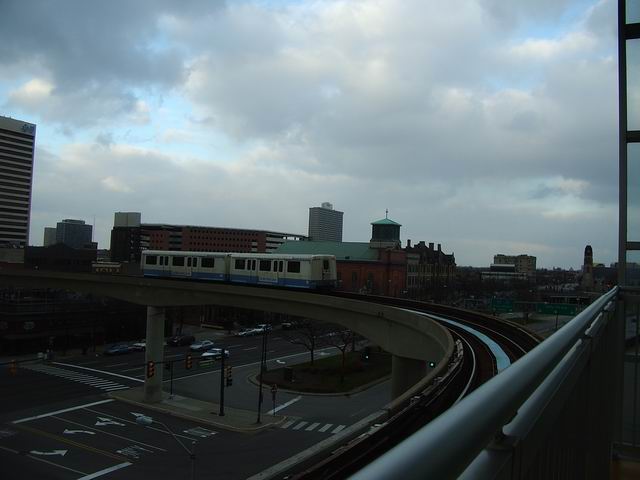
<p>After a few orbits around the circulation ring, we finally figured out where the People Mover was. We paid our 50-cent fare, and boarded the train. The only other passengers riding the People Mover were a lovey-dovey couple and a bum who stunk up half the car. The love-birds got off two stops later at Greektown, leaving us with the homeless man for half of the loop.</p>
<p><img height="240" style="margin:5px;" width="320" alt="" title="The Detroit People Mover" src="http://www.ettkin.net/weblog/2006-12-04%20129.JPG" /></p>
<p>The People Mover seems to be a good idea gone bad, like so many urban renewal efforts. It's a great idea to have a means of transport for tourists. But it would be helpful if that transport actually had places to take tourists. The entire trip around downtown Detroit took about ten minutes. Six stops after the bum left us, we were back where we started.</p>
<p>The People Mover could be a great way to show off a city. But first you have to have things to show off. In fact, Detroit might be better off if the People Mover were underground. By being high up, it gives passengers a greater view of the city. I'm not sure that's a good thing. We had terrific views of gritty streets and abandoned buildings. Melanie, who's traveled all over the Middle East, commented, &quot;It's like Beirut without the live shells.&quot; Indeed, our loop around Detroit was a depressing testament to a dying city.</p>
<p><img height="320" style="margin:5px;" width="240" alt="" title="Views from the Detroit People Mover" src="http://www.ettkin.net/weblog/2006-12-04%20113.JPG" /><img height="240" style="margin:5px;" width="320" alt="" title="Views from the Detroit People Mover" src="http://www.ettkin.net/weblog/2006-12-04%20114.JPG" /></p>
<p>After the first loop, we continued back to Greektown. It seemed to be the only part of downtown with any signs of activity whatsoever. </p>
<p>We walked through the entrance from the People Mover, and we were shocked to find a casino. I guess laws have changed, and any city can build a casino these days.</p>
<p>The real shocker was that the casino was packed! The streets of Detroit were empty, but on this Sunday afternoon, the gambling halls were filled. Some people were even in their Sunday finest, apparently following their church ablutions with the hopes that God might favor them with a cash bonanza at the Greektown Casino.</p>
<p>Melanie and I wandered the smoke-filled, people-filled casinos. It was much larger than we expected, and it was packed. It was quite a shocker. </p>
<p>Casinos are the death knell to urban development. It's what communities do when nothing else has worked, as is clearly the case in Detroit. And it's amazing how well casinos work. But you really have to question what benefit they will bring to the city. Tax revenues will go up, for sure. But the demographic that goes to these types of casinos are hardly high-rollers who can afford to spend their modest incomes on slots and roulette. There may be some job creation, but it's hardly a productive sector and the wages are unlikely to be very good. Casinos may also create jobs in secondary service sectors, such as restaurants and hotels, but these are also lower wage positions. Worst of all, as casinos proliferate in poor cities and Native American reservations, the marginal value of the casinos will also decrease because they will compete against each other more and more. It's really hard to imagine that Greektown, Detroit, such as it still survives, will contribute much to the city's long-term development.</p>
<p><img height="240" style="margin:5px;" width="320" alt="" title="All That's Greek about Greektown, Detroit" src="http://www.ettkin.net/weblog/2006-12-04%20105.JPG" /></p>
<p align="center">* * * * *</p>
<p>As our twenty-four hours in Detroit came to a close, Melanie and I, somewhat bewildered, returned to the hotel. We grabbed my things so I could get to the bus between Detroit and Windsor. For some reason, the schedule we had was wrong, and we just missed the bus, leaving one last misadventure before I left.</p>
<p>With no other option for me to catch my train, Melanie put me on a taxi, which would take me across the border for $55! And I thought we were done with taxis!</p>
<p>Candidate #4 for Detroit's craziest cab driver was a religious man. He had three crosses and a &quot;Jesus loves you!&quot; sign hanging from his rear-view mirror. An open bible lay across the dash. I prayed that he wouldn't look for inspiration while driving. Cabbie-for-Christ drove with the heat turned on high, the windows closed, and a cigarette in a holder hanging out his mouth.</p>
<p>&quot;Where you headed to from Windsor?&quot;</p>
<p>&quot;Toronto.&quot;</p>
<p>&quot;Oh, Toronto. That's a nice city. I haven't been there in a long time, but it's a nice city, pretty cold right now, but it's been a while since I've been there, but it's pretty nice, right?&quot;</p>
<p>He then proceeded to tell me that he needed to get back to the hotel because he was waiting for another fare. This was apparently some guy who had paid him in advance. The gentleman was also an alcoholic who had already drunk a case of beer. I thanked the reverend for the information.</p>
<p>When we got to the Canadian checkpoint, the cabbie decided to share this information with the immigration agent. Unfortunately, not much of what the taxi driver had to say was very coherent, and all the agent heard was &quot;He's got a case of beer.&quot;</p>
<p>&quot;What's that about a case of beer?&quot; he asked, looking a bit alarmed. Then he looked at me sternly.</p>
<p>&quot;He drunk a whole case of beer, I tell you!&quot;</p>
<p>Mortified, I told the agent that he's talking about another fare, not me. Confused, the agent waved us through, and the cabbie sped through Windsor to get me to the train station. I guess he had faith in a higher power, because his driving almost got us killed. </p>
<p>My friend Ejiro, a Detroit loyalist, will once again scold me, saying that twenty-four hours isn't enough to judge her hometown. But it was more than enough for me.</p>
<p>We drove along the river front, and I looked out at the skyline of Detroit. Part of me felt sad for the Windsorians who had to spend glum winter days looking at the decrepit city. On the other hand, I thought, it doesn't look so bad from a distance, separated by a river and a national border. Perhaps that's how Detroit should be experienced...in small doses and from a distance...quite a distance. . </p>
<p>I boarded my train and happily sped away, away from Detroit back to Toronto. A nice city, a good city, one in which I hadn't been in for just over twenty four hours, but it felt like years. Ahh, it'll be good to be back, I thought, and relaxed as the train put more distance between me and Detroit.</p>
<p></p>
<p style="color:#008;text-align:right;"><small><em>Powered by</em> <a href="http://www.qumana.com/">Qumana</a></small></p>
]]>
        
    </content>
</entry>
<entry>
    <title>Toronto the...Closed?</title>
    <link rel="alternate" type="text/html" href="http://www.ettkin.net/weblog/2006/10/toronto_theclosed.html" />
    <link rel="service.edit" type="application/atom+xml" href="http://www.ettkin.net/cgi-bin/mt/mt-atom.cgi/weblog/blog_id=1/entry_id=26" title="Toronto the...Closed?" />
    <id>tag:www.ettkin.net,2006:/weblog//1.26</id>
    
    <published>2006-10-17T17:18:53Z</published>
    <updated>2006-10-17T17:22:03Z</updated>
    
    <summary>Very soon, we will have passed the eight-month mark for our move to Toronto--what amounted to a leap-of-faith in both our relationship and the possibilities available to me in Toronto for my career. Eight months in, I have no doubts about my first leap-of-faith, but I am starting to question the veracity of the second. Toronto goes by several nicknames,...</summary>
    <author>
        <name>Brian Ettkin</name>
        
    </author>
            <category term="Canada" />
            <category term="Reflections" />
    
    <content type="html" xml:lang="en" xml:base="http://www.ettkin.net/weblog/">
        <![CDATA[<p>Very soon, we will have passed the eight-month mark for our move to Toronto--what amounted to a leap-of-faith in both our relationship and the possibilities available to me in Toronto for my career. Eight months in,  I have no doubts about my first leap-of-faith, but I am starting to question the veracity of the second.</p>
<p>Toronto goes by several nicknames, one of which is Toronto the Good. The city is definitely a nice one. It has a vibrant downtown that is relatively clean and relatively safe. And the people seem to be nice. Don't get me wrong. But the good people of Toronto are also among the most closed I have ever encountered, especially in an urban metropolis. As someone who has lived on three continents, in four countries and nearly a dozen cities, I feel that I have some perspective on the matter. That's why &quot;Toronto the Closed&quot; seems a more apt moniker for this city.</p>
<p>There is quite a bit of irony in all this. Toronto is one of the most multicultural cities in the world. Probably half the population is comprised of immigrants from other countries, speaking nearly a hundred different languges. You would think that such diversity would spawn openness and acceptance and, most importantly, empathy for what it means to be a stranger in a strange land. </p>
<p>Toronto is the largest city in Canada and it fancies itself the economic center of the country. Bay Street is a little cousin to Wall Street. All the banks have their headquarters here, as do the majority of large Canadian and multinational firms operating in Canada. Toronto is also the media hub for Canada, with most of the major networks, cable channels, movie studios and print media based here.</p>
<p>So, in the eyes of many Torontonians, at least so it seems to me, their fair city is the booming metropolis at the center of the world of Canadiana. In a way, it's a bizarre type of provincialism. Sure, New Yorkers also think they are the center of the world, but then again, they are, aren't they? New York is truly a global city, matched perhaps only by London. Toronto, on the other hand, is large only by Canadian standards. Three to four million people in an expansive nation of 33 million is large. But by American standards, it's somewhere between Minneapolis-St. Paul and Atlanta, with &quot;Minnesota nice&quot; surpassing &quot;Toronto goodness&quot; in terms of openness.</p>
<p>I hate to knock on the good folk of Toronto. I've certainly met plenty of nice people. Nevertheless, I can't quite comprehend the closed nature of the social world here. My friend Sharon Tennison, president of CCI in San Francisco, likes to talk about pods to refer to the small, closed social groups that people isolate themselves within. But for her, pods talk about interactions between Russians, a notoriously closed people. Russians can be rather suspicious of people they don't know well, but they have historically justified reasons for not trusting strangers. And once you have earned their trust, Russians are among the warmest people in the world, willing to give you the shirt off their back.</p>
<p>The Torontonians I've encountered also seem to be like pod-people. Many of the people I've been introduced to in the past eight months are quite nice individuals. But beyond initial meetings over lunch or coffee, things don't go much further. It's as if they've achieved a comfortable equilibrium in their lives--they've balanced the social equation--and they don't want to introduce another variable to upset the balance.</p>
<p>The odd thing is that the pod-people pop up in the oddest places. I've recently become more active in professional networking organizations--the express purpose of which should be to meet new people and expand your social network, right? But even at these events, I find it slow-going. At first I thought it was me. My introverted nature makes it difficult for me to do the small-talk thing at networking events. But when needed, I can definitely put on the charm and work a room. Unfortunately, at most of these so-called networking events, the room seems unworkable. It's like a high school dance, where people stand around in the cliques of people they already know, wary of newcomers. When you try to introduce yourself and engage people in conversation, they don't hold up their end of the banter. Small talk is a game, after all, and it takes two to play. </p>
<p>Why do my serves across the small-talk court always seem to default? What is it about Torontonians that makes them so closed-off to new relationships? If at first I thought it was just me--maybe my bad hair or geeky demeanor--it turns out that I'm not the only outsider to have experienced the Toronto cold shoulder. One of my new friends, also an American, who is far more gregarious and charming than I, told me that he has had similar frustrations here. And he's lived here for nearly five years!</p>
<p>I'm not sure what the sociology or social psychology at play here is. It could be several factors. Canadians themselves are quite a bit less mobile than Americans. Over the course of a lifetime, they are less likely to move around, to live, and to work in different locales as Americans. They may travel the world, but being a tourist is not the same as living in a new, strange place.</p>
<p>In my experience as a highly transient person (I haven't lived in one place for more than three years in the past eleven years!), people who have moved around have a very different perspective on things. First, they have a broader view of the world, because they have seen firsthand that the world is bigger than the little corner you live in. Second, they have been outsiders. Whenever you move to a new place, you have to struggle with a sense of not belonging because you have lost the tribal connections of the place you grew up in.You have no pod, as it were. That means you don't have the immediate support of your family or school friends. Initially, you struggle with the isolation, but you also seek out new connections and you make new friends.</p>
<p>My take on it is that this mobility makes your more empathetic to others who might be in the same situation. And just as you had to reach out when you were a newcomer, you respond to the reaching out of others. This makes for a more vibrant process of networking. And sure as hell makes for better small talk. Communities with a higher proportion of mobile individuals have better and faster opportunities for social networking. Just look at universities, where nearly everybody is an outsider. And I'm not just talking about students. Growing up, my father, a university professor, would always invite new faculty or international students to our house for dinner to help them feel more a part of the community. This is a value that I guess previously took for granted.</p>
<p>(Side note: Of course, here's another peculiarity of Toronto. Supposedly, Canada's leading institution of higher education, the University of Toronto is remarkably provincial. Forty four percent of living graduates still live in Toronto. A full 82 percent live in Ontario, mostly in the area surrounding Toronto. And nearly 80 percent of the undergraduate population is from Toronto. So, instead of creating a dynamic, geographically diverse social network, the institution of the U of T is essentially a very large pod, a good-old-boys club of well-established and conservative social links. I would imagine that other institutions, such as Ryerson, are similar in their geographic (though not socio-economic) homogeneity.)</p>
<p>Let's take a look at another great, multicultural city: San Francisco. I recently read that three-quarters of San Franciscans are originally from outside California. It's a city of newcomers. Indeed, San Francisco is a gold-rush city, and to this day has that peculiar California energy of new opportunities, of new potential, of ever-broadening frontiers. People in San Francisco are great networkers. Perhaps that's why so many people fall in love with the city.</p>
<p>Not surprisingly, the strongest relationships I've built since moving to Toronto have been with people who themselves are not from Toronto. Among Canadians, these are people who only recently moved to the city and also are struggling with making a new life in Toronto the Closed. And the warmest reception has come from non-Canadians. Strangely enough, we received two invitations for Canadian Thanksgiving Dinner. Both invitations came from American transplants now living in Toronto. Maybe they understand better what it's like to be new to a city. And I am very thankful to them both for warmly opening up their pods to us.</p>
<p></p>
<p style="color:#008;text-align:right;"><small><em>Powered by</em> <a href="http://www.qumana.com/">Qumana</a></small></p>
]]>
        
    </content>
</entry>
<entry>
    <title>Innovation? Talent Crunch? Give me a break!</title>
    <link rel="alternate" type="text/html" href="http://www.ettkin.net/weblog/2006/10/innovation_talent_crunch_give.html" />
    <link rel="service.edit" type="application/atom+xml" href="http://www.ettkin.net/cgi-bin/mt/mt-atom.cgi/weblog/blog_id=1/entry_id=25" title="Innovation? Talent Crunch? Give me a break!" />
    <id>tag:www.ettkin.net,2006:/weblog//1.25</id>
    
    <published>2006-10-06T23:09:54Z</published>
    <updated>2006-10-06T23:11:18Z</updated>
    
    <summary><![CDATA[Okay, it's time for me to get something off my chest. What is it with all the talk about innovation and talent? Yesterday, I attended an American Marketing Association seminar on the lack of innovation in marketing, and the magazine BusinessWeek has decided to make 2006 the &quot;Year of Innovation.&quot; Today, I see that the cover story of The Economist...]]></summary>
    <author>
        <name>Brian Ettkin</name>
        
    </author>
            <category term="Canada" />
            <category term="Personal Updates" />
            <category term="Reflections" />
    
    <content type="html" xml:lang="en" xml:base="http://www.ettkin.net/weblog/">
        <![CDATA[<p>Okay, it's time for me to get something off my chest. What is it with all the talk about innovation and talent? Yesterday, I attended an American Marketing Association seminar on the lack of innovation in marketing, and the magazine <em>BusinessWeek</em> has decided to make 2006 the &quot;Year of Innovation.&quot; Today, I see that the cover story of The Economist is dedicated to an apparent deficit in &quot;talent.&quot; As a person who has been searching for a career opportunity in Toronto for more than six months, it certainly doesn't feel like employers are hurting for bright young workers, and I'm damn tired of hearing about it!</p>
<p>As a person who's studied more than his fair share of demographic trends, I don't doubt that the impending retirement of an entire generation of baby boomers will have an impact on the labor market. But does that mean there's really a shortage of talent, or that the lack of qualified individuals is the only piece of the puzzle?</p>
<p>Here I am--smart, well educated, trilingual, and with a combination of unique experiences that few of my peers can claim--and not one of Toronto's companies has contacted me about job opportunities. And believe me, it's not for lack of trying on my part. I've sent out nearly a hundred resumes in the past six months, and they all seem to disappear into the ether.</p>
<p>Maybe there's something wrong with me. I admit that I'm not a &quot;traditional&quot; job candidate, but in my humble opinion, that's what makes me such an attractive candidate. I have a solid liberal arts background that trained me to identify, analyze, and solve problems--regardless of the field. We live in an increasingly globalized society, and my experience living and working in Japan and Russia have given me firsthand knowledge about successfully working across cultures. Three years I spent as a volunteer in the U.S. Peace Corps, which more than any MBA course taught me how to deal with ambiguity and to initiate complex and ambitious projects with nearly no resources. Oh, and I do have business experience and professional training and an MBA and an MA. So what is it that employers are looking for that I don't have?</p>
<p>Here's the thing about buzzwords likes &quot;innovation&quot; and &quot;talent.&quot; That's all they are to most organizations: cliches. The panel of speakers at yesterday's AMA meeting gave a lot of good insights about innovation, but no methodology will do any good if the culture of the company is fundamentally risk averse.</p>
<p>After all, there are really two sides of innovation. One side involves finding new solutions for problems or new ways of seeing things that others haven't thought of. If somebody else had thought of it...it wouldn't be innovative! But the other side of innovation is taking the risk to do something different once you've identified what it is. Having a fresh idea is not the same as acting upon that fresh idea. But because it's new and untested, there's always a risk of failure. But failure is not a bad thing when it's accompanied by a desire to learn and improve. Then, failure simply becomes a feedback mechanism that gives you guidance for formulating your next innovation.</p>
<p>Companies say they want to be innovative and they want to attract talent, but is that really true? Most corporations today seem to be technocracies--those who get ahead are those who do a particular skill well. Employees are rewarded for their proficiency in completing their function. Employees have no incentive to take risks. Many managers, then, are technocrats who have gotten ahead by being good at their technical area. It's no wonder that when hiring new employees, managers look for other technically proficient people whose background mirrors their own. These are the results that get rewarded by the system; but this is not a system that inculcates innovation and it is certainly not a reflection of talent.</p>
<p>Innovation is not technical skill. Talent is not technical skill. This is not to say that technical proficiency isn't important. Of course it is. But many skills are simply learned activities. But that you have mastered a skill does not mean that you are talented at it, nor does it mean that you are capable of being innovative in your field. Don't misread me as being arrogant, and don't get me wrong. I'm not belittling the achievement of people who have worked hard to learn their professional field.</p>
<p>But the mindset behind innovative thinking requires the ability to think outside of familiar paradigms. I'm trying to avoid the &quot;think outside the box&quot; cliche. And guess what: the world looks different when you look at it from a different paradigm. That's where innovative people gain the insight to come up with innovation--which later they can apply to technical skills. It's far easier for a person who has cultivated the capacity for critical thinking (and cultivate is the appropriate word) to pick up additional skills than it is for a person who has focused on rote technical proficiency to later develop the sense of wonder and curiosity necessary to question the status quo--what Zen Master Suzuki called &quot;shoshin&quot; or &quot;beginner's mind.&quot; </p>
<p>If it were so easy, more companies would be innovative, right? There are plenty of accountants, financial managers, investment bankers, engineers, marketers, and so on who are extremely competent at what they do, and I have no doubt that they know their shit better than I do. But what does it mean that companies are bitching and moaning about innovation yet they continue to hire and encourage technocratically proficient candidates rather than more untraditional ones?</p>
<p>One of the participants in the AMA seminar was a former Kraft marketing manager. He noted that the bean counters have laid siege upon the modern corporation. They manage almost entirely by numbers and analysis and most importantly, quarterly reports. The hot new jobs are &quot;risk analysts,&quot; which reflects the risk-averse orientation of most big companies. While strong analysis is important, as is calculated risk taking, this trend has created a culture counterproductive to creativity and, therefore, innovation. The former Kraft manager's expression was that &quot;there's no place for the wingnuts in marketing anymore.&quot; By &quot;wingnuts,&quot; he meant the innovative thinkers who are able and willing to look at the business landscape from an entirely different perspective. Moreover, they're willing to take the risk of implementing a &quot;wild and crazy&quot; idea. That idea might be so innovative that traditional &quot;metrics&quot; are incapable of predicting the probable outcomes, which is probably why they usually get nixed by the C-suite.</p>
<p>Companies want growth and they want to maximize shareholder return. But have they forgotten the fundamental principle of finance: the risk-return relationship. If you want higher returns, you have to be willing to accept greater risk.And this is going to be true throughout the company and the decisions you make--including hiring.</p>
<p>Though certainly necessary, technical specialists are safe hires. &quot;Wingnuts&quot;--i.e., innovators--are risky hires. But if employers want to &quot;diversify their portfolio&quot; of employees to maximize shareholder value, then they must be willing to hire talent that doesn't fit the cookie-cutter mold of business school graduates in gray pinstripe suits. What are the risks? First, the person may not be fully proficient in a certain technical area, and the employer will have to invest a little more at the front end for the innovator to get up to speed. Second, cultural frictions may arise when the safe way of doing things comes into conflict with the innovative perspective.</p>
<p>These risks can be mitigated if employers are willing to see their hiring decisions as investments. In most cases, your &quot;wingnut&quot;--with a liberal education focused on critical thinking--will move quickly along the learning curve when it comes to technical skills. After the initial investment to train the person--and you have to be willing to make this commitment to mentoring the new employee--you will be rewarded very soon and very well by the creative enthusiasm that your wingnut will bring to his or her work. As for the cultural issue--an effective manager will embrace the change and welcome the dialogue that emerges. In time, the addition of more wingnuts will help invigorate the culture and shift the organizational mentality to a more innovative one.</p>
<p>So, here I am, a lone &quot;wingnut,&quot; working from my 25th floor home for a start-up company (entrepreneurs are wingnuts!) based in California (the land of wingnuts!), and I'm still baffled by the calls for more talent and innovation. Here I am world! I'm well-trained, with unique experiences and top-notch education. I'm ready and willing to join your team. Stop complaining about the talent shortage and hire me already!</p>
<p style="color:#008;text-align:right;"><small><em>Powered by</em> <a href="http://www.qumana.com/">Qumana</a></small></p>
]]>
        
    </content>
</entry>
<entry>
    <title>On Turning 30, Two Weeks Late</title>
    <link rel="alternate" type="text/html" href="http://www.ettkin.net/weblog/2006/09/on_turning_30_two_weeks_late.html" />
    <link rel="service.edit" type="application/atom+xml" href="http://www.ettkin.net/cgi-bin/mt/mt-atom.cgi/weblog/blog_id=1/entry_id=24" title="On Turning 30, Two Weeks Late" />
    <id>tag:www.ettkin.net,2006:/weblog//1.24</id>
    
    <published>2006-09-25T12:53:34Z</published>
    <updated>2006-09-25T13:10:38Z</updated>
    
    <summary>This September, the Hebrew Calendar started the new year of 5767, and I passed the far more humble but perhaps personally more significant 30th Birthday. That it&apos;s taken me fifteen days to make mention of this shouldn&apos;t be taken as frustration at growing older. Unlike many people, hitting the 30 year-old milestone does not depress me. Of the many things...</summary>
    <author>
        <name>Brian Ettkin</name>
        
    </author>
            <category term="Personal Updates" />
            <category term="Reflections" />
    
    <content type="html" xml:lang="en" xml:base="http://www.ettkin.net/weblog/">
        <![CDATA[<p align="justify">This September, the Hebrew Calendar started the new year of 5767, and I passed the far more humble but perhaps personally more significant 30th Birthday. That it's taken me fifteen days to make mention of this shouldn't be taken as frustration at growing older. Unlike many people, hitting the 30 year-old milestone does not depress me. Of the many things I potentially become neurotic about, growing older is not one of them.</p>
<p align="justify">Why should I? In thirty years, I've managed to do quite a bit. I've lived and traveled around the world--Japan, Russia, China, Italy, Canada. I spent three years in the Peace Corps trying to do my bit to make the world a better place. I earned two master's degrees. And I not only found somebody to love and be loved by, but I've even managed to be able to live with him. As the sun rises and fills our 25th floor apartment with light and warmth, I can't help but think that this is a good place to be at thirty.</p>
<p align="justify">There are some things that have left me depressed over the past couple of months. Not having a job is the first and foremost problem. After seven months, my professional fortunes in Toronto have not changed. It's a bit disheartening to look at my friends and classmates who at my age already have well-established careers, houses and even children--and then to think that I'm still just starting. This makes me a youthful 30, I suppose, since until now I'd felt like the perpetual student. But, dammit, I'm ready to grow up!</p>
<p align="justify">What is encouraging now is the definite change in fortunes that seems to be occurring in Toronto. This has been an unusually hard city for us to break into. People are friendly but closed, making it difficult to meet new friends. But since mid-August, we have slowly started to develop a network of friends (almost all of whom are not native to Toronto), and that has been probably the best birthday gift of all. Hitting thirty with no one to share a cake with is not much fun. Luckily, we had at least a couple of people who gave me the gift of eating cake on my birthday.</p>
<p align="justify">So another day, another Monday, another Jewish New Year, and it's time to move forward so that this decade will be even better than the last. </p>
<p style="color:#008;text-align:right;"><small><em>Powered by</em> <a href="http://www.qumana.com/">Qumana</a></small></p>
]]>
        
    </content>
</entry>
<entry>
    <title>Globally Connected</title>
    <link rel="alternate" type="text/html" href="http://www.ettkin.net/weblog/2006/09/globally_connected.html" />
    <link rel="service.edit" type="application/atom+xml" href="http://www.ettkin.net/cgi-bin/mt/mt-atom.cgi/weblog/blog_id=1/entry_id=23" title="Globally Connected" />
    <id>tag:www.ettkin.net,2006:/weblog//1.23</id>
    
    <published>2006-09-07T16:49:44Z</published>
    <updated>2006-09-07T17:02:50Z</updated>
    
    <summary>Here I am, on a Thursday morning, sitting in my downtown Toronto apartment. My quixotic job search has been interrupted by several conversations with dear friends. When I begin to wonder whether the meandering path of my past ten years was spent in vain, these friends pop up and remind me of all the wonderful people I&apos;ve met around the...</summary>
    <author>
        <name>Brian Ettkin</name>
        
    </author>
            <category term="Reflections" />
    
    <content type="html" xml:lang="en" xml:base="http://www.ettkin.net/weblog/">
        <![CDATA[<p>Here I am, on a Thursday morning, sitting in my downtown Toronto apartment. My quixotic job search has been interrupted by several conversations with dear friends. When I begin to wonder whether the meandering path of my past ten years was spent in vain, these friends pop up and remind me of all the wonderful people I've met around the world.  In one window, I'm chatting with my friend Oksana--who is changing the world in Darfur. Another window takes me to the world of my friend Thomas, who with his wife is making a difference in Panama as Peace Corps Volunteers. My dear, dear friend Rebecca has her shit-kickers on and is getting coffee farmers in Guatemala competitive for the global market. All these incredible people doing incredible things in far out places. What a blessing to know them all and to be able to stay in touch with them. It's worth taking a couple hours out of my day to keep in touch--and keep myself grounded.</p>
<p style="color:#008;text-align:right;"><small><em>Powered by</em> <a href="http://www.qumana.com/">Qumana</a></small></p>
]]>
        
    </content>
</entry>
<entry>
    <title>God Bless Canadian Immigration!</title>
    <link rel="alternate" type="text/html" href="http://www.ettkin.net/weblog/2006/08/god_bless_canadian_immigration.html" />
    <link rel="service.edit" type="application/atom+xml" href="http://www.ettkin.net/cgi-bin/mt/mt-atom.cgi/weblog/blog_id=1/entry_id=22" title="God Bless Canadian Immigration!" />
    <id>tag:www.ettkin.net,2006:/weblog//1.22</id>
    
    <published>2006-08-11T15:36:28Z</published>
    <updated>2006-08-11T15:49:50Z</updated>
    
    <summary>Oh my. How could I let so much time go by and not let people know what&apos;s going on? Six weeks since my last post! Two weeks since I go some very good news: The Canadian Government granted my request for an open work permit. I guess the silence was a reflection of the funk I was settling into, but...</summary>
    <author>
        <name>Brian Ettkin</name>
        
    </author>
            <category term="Canada" />
            <category term="Personal Updates" />
    
    <content type="html" xml:lang="en" xml:base="http://www.ettkin.net/weblog/">
        <![CDATA[<p>Oh my. How could I let so much time go by and not let people know what's going on? Six weeks since my last post! Two weeks since I go some very good news: The Canadian Government granted my request for an open work permit. I guess the silence was a reflection of the funk I was settling into, but now that I have my work permit, there's no excuse for the funk. I gotta get my ass out of the chair and in gear. Time to find a job!</p>
<p>And on one last note: God Bless Canada! I've noticed that Canadians have a tendency to bemoan their government bureaucracy, but I am repeatedly convinced that the opposite is true: Canada has one of the fairest, most objective and most streamlined government bureaucracies I've ever encountered. Is it perfect? Of course, not. But their policies are clear and rational. Their requirements are reasonable. Processes are straightforward. Most importantly, Canada is one of the few countries that recognizes the legitimacy of our relationship, thereby offering me the opportunity to receive this work permit.</p>
<p>Now I just need to figure out what I want to be when I grow up!</p>
<p style="color:#008;text-align:right;"><small><em>Powered by</em> <a href="http://www.qumana.com/">Qumana</a></small></p>
]]>
        
    </content>
</entry>
<entry>
    <title>Liking Nacho Libre</title>
    <link rel="alternate" type="text/html" href="http://www.ettkin.net/weblog/2006/06/liking_nacho_libre.html" />
    <link rel="service.edit" type="application/atom+xml" href="http://www.ettkin.net/cgi-bin/mt/mt-atom.cgi/weblog/blog_id=1/entry_id=21" title="Liking Nacho Libre" />
    <id>tag:www.ettkin.net,2006:/weblog//1.21</id>
    
    <published>2006-06-27T13:58:25Z</published>
    <updated>2006-06-27T08:51:26Z</updated>
    
    <summary> It should have been a film that embarrassed me to admit I liked. I usually pass on movies with comedic actors like Jack Black in the leading role. Like the many bad Will Farrell or Jim Carrey movies out there, stupid comedies have a knack for catching up with me, whether I want to see them or not. I...</summary>
    <author>
        <name>Brian Ettkin</name>
        
    </author>
            <category term="Culture" />
            <category term="Movies" />
    
    <content type="html" xml:lang="en" xml:base="http://www.ettkin.net/weblog/">
        <![CDATA[<iframe src="http://rcm.amazon.com/e/cm?t=briapettkanam-20&o=1&p=13&l=st1&mode=dvd&search=Nacho%20Libre&=1&fc1=&lt1=&lc1=&bg1=&f=ifr" marginwidth="0" marginheight="0" width="468" height="60" border="0" frameborder="0" style="border:none;" scrolling="no"></iframe>
<p>It should have been a film that embarrassed me to admit I liked. I usually pass on movies with comedic actors like Jack Black in the leading role. Like the many bad Will Farrell or Jim Carrey movies out there, stupid comedies have a knack for catching up with me, whether I want to see them or not. I still cringe at the memory of being subjected to <em>Anchorman</em> on an airplane--a flop that has found a place on my list of worst movies of all time.</p>
<p>So I am a bit surprised that on Saturday night I not only saw <em>Nacho Libre</em>, I not only paid to see it, but I paid <strong>full ticket price</strong> to do so. And the strangest thing of all is that I really liked it.</p>
<p>The movie tells the story of a misplaced Mexican monk who toils away in an impoverished orphanage. But despite his vows, he longs to fulfill his dream of becoming a &quot;Luchador&quot;--a professional wrestler. The plot is fairly simple, with the expected twists and even an unrequited love interest in the person of a nun. Our erstwhile friar acquires an unwilling sidekick to help him become a great wrestler. The trappings of the Luchador life distract them from what's really important in life. Only when they focus on helping the orphans do their fortunes improve.</p>
<p>The movie is simple, and some of the humor is typically crass. (Flatulence plays a large role.) What makes the film stand out is that, despite the slapstick and the toilet jokes, it is nonetheless subdued. Unlike <em>School of Rock, </em>for example, <em>Nacho Libre</em> does not try to fill every moment with humor. Nor are the jokes always handed to you on a plate. Jared Hess, the director and co-author of the screenplay, keeps Jack Black in control throughout the movie. We all know that Black can be outrageous, but he is far funnier when he's not. It's this carefully subtlety that makes <em>Nacho Libre</em> stand out. My friend Micah says that &quot;subdued&quot; humor is in style these days. I never saw <em>Napoleon Dynamite</em>, Hess' previous movie, and I can't really testify to the prevalence of subdued humor, since I tend to avoid most comedies targeted to young adult audiences. But if this is the trend, and if filmmakers can maintain this level of quality, I'm all for it.</p>
<p>Jack Black is well complemented by the Mexican cast of <em>Nacho Libre.</em> Esqueleto, Nacho's sidekick, is a very well-crafted character played superbly by Héctor Jiménez. Hess' decision to film in Mexico and use a Mexican cast adds integrity to the film. Apparently, some people find <em>Nacho Libre</em> racist, but I think such criticisms reveal over-sensitive political correctness that could do with a good ideological root canal. Showing ethnic idiosyncrasies does not make a film racist, and <em>Nacho Libre </em>never pretends to represent &quot;Mexicans&quot; as inherently this or that. These quirks are part of the flavor of cultures, and there would be nothing worthwhile about a film with a bunch white-washed &quot;Latino&quot; actors playing well-rehearsed lines with the only thing Mexican about the film being the colors of the set on the stage and the ethnicity of the players and a mariachi band on the soundtrack. Once we start going down the path of over-sensitivity, all that is left to art is bland sameness which can never be art because it never addresses the differences and without differences what do we have to learn from each other?</p>
<p>I would not go so far as to label <em>Nacho Libre</em> as &quot;social commentary.&quot; There is no deeper message than the simple truth that the things worth fighting for are the things that are bigger than you. But it is a nice film, good for some laughs and a refreshing take on a tired genre.</p>
<p><small>Tags: <a rel="tag" href="http://technorati.com/tag/Nacho+LIbre">Nacho LIbre</a>, <a rel="tag" href="http://technorati.com/tag/film">film</a>, <a rel="tag" href="http://technorati.com/tag/movies">movies</a>, <a rel="tag" href="http://technorati.com/tag/Jack+Black">Jack Black</a>, <a rel="tag" href="http://technorati.com/tag/Jared+Hess">Jared Hess</a>, <a rel="tag" href="http://technorati.com/tag/Hector+Jimenez">Hector Jimenez</a></small></p>
<p style="color:#008;text-align:right;"><small><em>Powered by</em> <a href="http://www.qumana.com/">Qumana</a></small></p>
]]>
        
    </content>
</entry>
<entry>
    <title>Starting Over, or The Dangers of Daytime Telly</title>
    <link rel="alternate" type="text/html" href="http://www.ettkin.net/weblog/2006/06/starting_over_or_the_dangers_o.html" />
    <link rel="service.edit" type="application/atom+xml" href="http://www.ettkin.net/cgi-bin/mt/mt-atom.cgi/weblog/blog_id=1/entry_id=20" title="Starting Over, or The Dangers of Daytime Telly" />
    <id>tag:www.ettkin.net,2006:/weblog//1.20</id>
    
    <published>2006-06-23T19:26:37Z</published>
    <updated>2006-06-23T13:29:22Z</updated>
    
    <summary> With the latest addition to our family--a cute little 20-inch Toshiba television--a new temptation sits in the corner of our living room. We originally bought the television after too many nights of sitting uncomfortably around my computer trying to watch some movies. Austerity is one thing, but considering the pressures of Andrey&apos;s job, we decided that it&apos;s important to...</summary>
    <author>
        <name>Brian Ettkin</name>
        
    </author>
            <category term="Culture" />
            <category term="Culture" />
            <category term="Reflections" />
    
    <content type="html" xml:lang="en" xml:base="http://www.ettkin.net/weblog/">
        <![CDATA[<iframe src="http://rcm.amazon.com/e/cm?t=briapettkanam-20&o=1&p=13&l=st1&mode=books&search=Rhonda%20Britten&=1&fc1=&lt1=&lc1=&bg1=&f=ifr" marginwidth="0" marginheight="0" width="468" height="60" border="0" frameborder="0" style="border:none;" scrolling="no"></iframe>
<p>With the latest addition to our family--a cute little 20-inch Toshiba television--a new temptation sits in the corner of our living room. We originally bought the television after too many nights of sitting uncomfortably around my computer trying to watch some movies. Austerity is one thing, but considering the pressures of Andrey's job, we decided that it's important to be able to come home after ten or eleven hours of work and just veg out for a bit in front of the TV.</p>
<p>For me, however, the television is just one more thing to distract me from more productive pursuits. Since I am working from home on some freelance projects, it requires quite a bit of will-power not to flip on the TV. I know many people like having it on as background noise, but for me that background noise too easily becomes foreground procrastination. I watched more than my fair share of afternoon reruns and prime time shows growing up, most of which, in retrospect, were fairly lame. In fact, I think most TV shows have gotten worse--especially the sitcom genre. </p>
<p>And so I am keenly aware of the dangers of having the TV around, and I try to keep my watching under control. There is, however, one show that has got me hooked, adding me to the ranks of the daytime TV addicts.</p>
<p>When I first saw <em><a href="http://www.startingovertv.com/">Starting Over</a></em>, an NBC production, I was rather skeptical. This daily program shows the lives of six women who have chosen to live in a house in the hills outside of LA. Under scrutiny of the TV cameras, they must address head on personal problems that are preventing them from living a meaningful, more-or-less normal life. Each woman has her own issue, but living together is part of the therapy. Three life coaches provide them individual and group guidance. Their continued residence in the house depends on their willingness and commitment to the process.</p>
<p>Initially, <em>Starting Over</em> seemed like one more twist on the reality TV genre--a genre that just won't die. Even worse, I thought it was another shallow, saccharine application of self-help pop psychology offering quick fixes to deep-seated psychological problems. Neither the participants nor viewers are well-served when TV &quot;experts&quot; dish out superficial advice geared primarily towards boosting ratings or their own book sales.</p>
<p><em>Starting Over </em>often was on TV at the same time I was at the gym doing my cardio routine. Since my choices were usually either FOX News, ESPN, some horrid soap opera, or <em>Starting Over</em>, I would invariably settle on <em>Starting Over</em>. The more I watched the show, the more I realized there is more to it than a cheap Dr. Phil moment. Now watching <em>Starting Over</em> is part of my morning routine--for better or for worse--which I can continue as long as I don't have regular employment.</p>
<p>What's the appeal of a reality TV show about six women trying to put their lives back together, especially for a young man who is clearly not the target demographic of this program?</p>
<p>As I watch the show, it has been compelling to get caught up in the personal struggles of each woman. The more I watch the show, the more depth each individual gains as a character. Accordingly, the more interested I become in their progress. </p>
<p>The struggles are real. Very little is white-washed or glossed over, and you get to see each woman's successes and failures. When someone backslides, there of course is a somewhat morbid interest in their fate, but their progress can be inspiring, too.</p>
<p>I imagine that part of the appeal of this show is not just detached interest. The intimacy of the show creates vulnerability, and you are drawn into the world of these women, who are living together in a house as they go through psychological boot camp. Ultimately, in the quirks of these women are not unfamiliar. We see ourselves in their struggles. Let me eliminate the &quot;Royal We.&quot; I see myself, my neuroses and my shortcomings. </p>
<p>The life coaches rip off the masks of denial and deception to expose painful truths. I watch and think about my own fears and masks. On the one hand, I am petrified at the thought that someone might force me to confront my self-deception--on national TV no less. But it is also exhilarating--the thought of penetrating that deeply into a level of self-understanding and awareness. </p>
<p>There is a certain integrity to the show. There are no easy fixes for these women. They must commit themselves to months of hard work and soul searching. The life coaches show that the process is frightening and sometimes painful. Most importantly, self-awareness and the resulting contentment can only come through consistent, honest, truthful hard work. This is more than you get from an hour with Dr. Phil or Oprah.</p>
<p>Some aspects of the show make me uncomfortable, but I suspect these are the limitations of the format. As viewers, we only see the &quot;entertaining&quot; moments of therapy. We see tears, fighting, bonding. We see interesting therapeutic tools, such as art projects or other exercise. What bothers me most is that many of the sessions with the life coaches focus on them giving the answers to the women. These make for nice sagely words of wisdom on daytime TV, but I'm not sure that it portrays an accurate picture of psychotherapy. My impression is that good therapists first listen, second ask questions that guide the individual to the truth, and only third state the problem clearly if and only if the individual hasn't really come to grips with the truth. I know there are different schools of psychoanalysis, but I thought that this was pretty common across methodologies. But long sessions &quot;on the couch&quot; don't make for good television.</p>
<p>In a way, <em>Starting Over</em> is my cheap form of therapy. My vicarious identification with the housemates brings attention to my shortcomings and at least makes me think about what I might do differently. Though we should shy away from universal prescriptions, the life coaches do offer some good strategies for peeling away our psychic layers to get to the heart of the matter. </p>
<p>At the end of the day, of course, it is incumbent upon me to move beyond vicariousness to active transformation. Rationalization of self-deceit is perhaps the most common trait of these women, and probably most people in general. But unlike these women, I don't have a life coach to hold me accountable and to challenge my deceptions. Like these women, the ultimate responsibility to change is mine, but sometimes it would be nice to have the external, objective voice to keep me on track.</p>
<p>And on that note, with the tube turned off, let's see what else I can get done today. Let's see if I can make every moment a <em>Starting Over</em> moment, full of awareness and right intention followed by right action.</p>
<p><small>Tags: <a rel="tag" href="http://technorati.com/tag/Starting+Over">Starting Over</a>, <a rel="tag" href="http://technorati.com/tag/psychology">psychology</a>, <a rel="tag" href="http://technorati.com/tag/television">television</a></small></p>
<p style="color:#008;text-align:right;"><small><em>Powered by</em> <a href="http://www.qumana.com/">Qumana</a></small></p>
]]>
        
    </content>
</entry>
<entry>
    <title>When Snobs Go Populist</title>
    <link rel="alternate" type="text/html" href="http://www.ettkin.net/weblog/2006/06/when_snobs_go_populist.html" />
    <link rel="service.edit" type="application/atom+xml" href="http://www.ettkin.net/cgi-bin/mt/mt-atom.cgi/weblog/blog_id=1/entry_id=19" title="When Snobs Go Populist" />
    <id>tag:www.ettkin.net,2006:/weblog//1.19</id>
    
    <published>2006-06-09T18:44:49Z</published>
    <updated>2006-06-09T19:01:39Z</updated>
    
    <summary> A recent New York Times book review really rubbed me the wrong way. It&apos;s one thing to disagree with the content or analysis. But it&apos;s quite another thing to veil base condescension in an appeal to populism or authority. I&apos;m not sure what else you could call Clive James&apos; recent review of American Movie Critics, a collection of film...</summary>
    <author>
        <name>Brian Ettkin</name>
        
    </author>
            <category term="Culture" />
            <category term="Movies" />
            <category term="Reflections" />
    
    <content type="html" xml:lang="en" xml:base="http://www.ettkin.net/weblog/">
        <![CDATA[<iframe src="http://rcm.amazon.com/e/cm?t=briapettkanam-20&o=1&p=8&l=as1&asins=1931082928&fc1=000000&IS2=1&lt1=_blank&lc1=0000ff&bc1=000000&bg1=ffffff&f=ifr" style="width:120px;height:240px;" scrolling="no" marginwidth="0" marginheight="0" frameborder="0"></iframe><br>
<p>A recent New York Times book review really rubbed me the wrong way. It's one thing to disagree with the content or analysis. But it's quite another thing to veil base condescension in an appeal to populism or authority. I'm not sure what else you could call Clive James' recent review of <em>American Movie Critics</em>, a collection of film reviews from the past century edited by Phillip Lopate. </p>
<p>It is surprising that the editors of the New York Times saw fit to waste as many column inches as they did on James' review, pompously titled <a href="http://www.nytimes.com/2006/06/04/books/review/04james.html?_r=1&pagewanted=all&oref=login">&quot;How to Write about Film.&quot;</a> They might have followed it with another piece called &quot;How NOT to Write about Books about Film.&quot; James seems more intent on showing us both his superior appreciation of film and his superior linguistic aptitude, and the book under consideration receives very little consideration. The volume becomes vehicle, and James disjointedly tells how we should think and write about movies.</p>
<p>The reviewer seems to prefer that we not think--especially if we don't think like him, and he veils his conceit in a sort of cinematic populism. He quips, &quot;In our appreciation of the arts, does a theory give us more to think about, or less? To me, the answer looks like less, but it could be that I just don't like it when a critic's hulking voice gets in the way of the projector beam and tries to convince me that what I am looking at makes its real sense only as part of a bigger pattern of thought, that pattern being available form the critic's mind at the price of decoding his prose.&quot;</p>
<p>At first glance, this position is reasonable. Rather than forcing a film into the artificial constraints of &quot;critical theory,&quot; why not evaluate a film on its success in telling a story? Often, such theories do little to help readers decide whether or not they want to spend $12.00 to see a movie, though theories do much to help young graduate students find dissertation topics. I entirely agree that most movies tell stories and serve primarily to entertain. I agree with James that when watching <em>The Hunt for Red October</em>, &quot;not even Sean Conery's shtrangely shibilant Shcottish ackshent as the commander of a Shoviet shubmarine&quot; prevents me from losing myself in the film. A film appreciation teacher I had in high school said that the true test of a film is whether or not you feel completely transported into another world, whether or not you disappear for two hours into the filmmaker's parallel dimension.</p>
<p>But to say that popular appeal supercedes all other considerations is to deny cinema a higher call to artistic expression. Certainly, expression must still adhere to certain aesthetic cinematographic conventions, but conventions can be manipulated, even distorted, to great effect in order that the filmmaker convey an unexpected vision. Indeed, that vision--what James calls a &quot;unifying theory&quot;--may be so unnerving and discomforting that the film may never be popularly accessible. But artists have long since struggled with the balance between public opinion and &quot;art for art's sake.&quot;</p>
<p>This discussion is not new, and we could extend it to any field of artistic endeavor. In literature, James Joyce and William Faulkner would have been given the axe early on had their publishers followed James' principle. For how many people can just pick up <em>Ulysses</em> or <em>The Sound and the Fury</em> and give them a quick read? The world would certainly be all the poorer if the Mississippi town of Oxford's only literary claim to fame was John Grisham--an author whose books have probably lapped Faulkner's novels in sales by some exponential factor.</p>
<p>Painters are no different. Since the last half of the 19th Century, artists have struggled to find new ways of expressing their creative vision. In many cases, the progression of their work is very closely tied to concrete theories. Without this creative freedom, our perception of reality would be limited to a very staid and boring realism. We wouldn't have Monet's impressionistic treatment of the cathedral in various hues and shades, nor would we have Picasso's bold inventions. Are these works always popular? Of course not. To this day I have fierce arguments with my Russian friends about modern art. They are all steeped in the Russian realist classics and cannot understand the appeal of Kandinsky or Miro. I can appreciate the technical mastery of picture-perfect landscapes or stilllife paintings, but I can't say that they transform my perception. They are showing me the world as we see it with our eyes and, therefore, are existing preconceptions. Art for art's sake serves to alter our perception, to make us see something deeper and, perhaps, more threatening in the world around us. Realism appeals to the senses because it is comforting, but wisdom does not arise from comfort, and we do not grow when we feel at ease. Who really wants to live in a saccharine, Thomas Kinkade world, blankly staring at a visual opiate for the masses?</p>
<p>Society, on the whole, makes room for writers to experiment and for painters to push the boundaries. Critics put these developments into a context that help us get beyond the first conceptual hurdles so that we can appreciate the new worldview that the artist is providing us. Why would we expect anything different for filmmakers? Tarkovsky or Fellini may not be immediately accessible to the average moviegoer, but that does not mean that we should dismiss their films. Nothing worthwhile is easy; the same is true with some of the most ambitious and revolutionary films.</p>
<p>At some points in his review, I felt like William F. Buckley, Jr., was condescending to explain to me all my intellectual frailties. James, for example, sees fit to demonstrate his superior appreciation of the English language in evaluating a sentence by the critic Otis Ferguson: &quot;Look at the perfect placement of that word 'violence,' for example. It's not enough to have the vocabulary. You have to have the sensory equipment.&quot; My goodness! Perhaps James should hide the Vaseline, get a Kleenex and put away his sensory equipment, because I'm not sure what to make of this manner of pedantic onanism.</p>
<p>James lifts the veil entirely by the end of his review and reveals his total conceit. First, in commenting on <em>Munich,</em> he notes that &quot;several quite good critics in various parts of the world knew there was something seriously wrong with Steven Spielberg's 'Munich,' but they didn't know how to take it down.&quot; Never fear! Where those &quot;quite good critics&quot; failed, James comes to rescue, saying that the the movie was &quot;written by people who don't know half enough about politics.&quot; Actually, after seeing the movie and then reading the original book, I concluded that the screenplay was just poorly written. But James, contrary to his criticism of critics, wants to unify his commentary under--surprise, surprise--a theory. For him this unifying principle is &quot;what makes the movie isn't just who directed it, or who's in it, it's how it relates to the real world.&quot;</p>
<p>To prove his point, he throws down his final snooty gauntlet, lest we still suspected him of being a populist in wolf's clothing. He concludes with a snip about the German film <em>Downfall</em>, which portrays the final days in Hitler's bunker. I thought the film to be quite good and quite even-keeled, given the subject matter. Silly me! James informs me &quot;if you know too much about the movies but not enough about the world, you won't be able to see that 'Downfall' is dangerously sentimental.&quot; Then he concludes: &quot;but to know why that is so, you have to have read a few books.&quot; </p>
<p>And so, there we have it: Clive James knows more about movies and history than I do. Because I found <em>Downfall</em> to be a fine treatment of a difficult subject, I must be an ignorant buffoon. I'm sorry, but as a queer Jew, I'm the last person to feel sentimental about Adolph Hitler or the Nazi regime--never mind the dozens of books on the Nazism that I HAVE read and never mind my sitting through a two-hour video interview with Hitler's secretary.</p>
<p>James grand finale returns to his pseudo-populist cry: &quot;No matter how many movies you have seen, they won't give you the truth of the matter, because it can't be shown as action. To know what can't be shown by the gag writers, however, you have to know about a world beyond the movies. But the best critics do, as this book proves; because when we say that the nontheorists are the better writers, that's what we mean. That extra edge that a good writer has is a knowledge of the world, transmuted into a style.&quot;</p>
<p>What comment can I add to that other than that 1) James obviously has his overarching theories and 2) what he really means is that a good writer should have James' understanding of the world.</p>
<p>At the end of the day, I do not advocate overt snobbism in the place of James' veiled sort. If there's enough room in the small town of Oxford, Mississippi, for both Faulkner and Grisham, there should be enough room in the film world for both X-Men and Satyricon. For me, a weekend watching Bond reruns on TBS is time well spent, but so is an evening at the art house watching some pomo experiment.</p>
<p><small>Tags: <a rel="tag" href="http://technorati.com/tag/film">film</a>, <a rel="tag" href="http://technorati.com/tag/New+York+Times">New York Times</a>, <a rel="tag" href="http://technorati.com/tag/Clive+James">Clive James</a>, <a rel="tag" href="http://technorati.com/tag/Munich">Munich</a>, <a rel="tag" href="http://technorati.com/tag/Downfall">Downfall</a>, <a rel="tag" href="http://technorati.com/tag/criticism">criticism</a>, <a rel="tag" href="http://technorati.com/tag/critics">critics</a>, <a rel="tag" href="http://technorati.com/tag/Phillip+Lapote">Phillip Lapote</a>, <a rel="tag" href="http://technorati.com/tag/American+Movie+Critics">American Movie Critics</a></small></p>
<p></p>
<p style="color:#008;text-align:right;"><small><em>Powered by</em> <a href="http://www.qumana.com/">Qumana</a></small></p>
]]>
        
    </content>
</entry>
<entry>
    <title>And now a word from Gorby</title>
    <link rel="alternate" type="text/html" href="http://www.ettkin.net/weblog/2006/06/and_now_a_word_from_gorby.html" />
    <link rel="service.edit" type="application/atom+xml" href="http://www.ettkin.net/cgi-bin/mt/mt-atom.cgi/weblog/blog_id=1/entry_id=18" title="And now a word from Gorby" />
    <id>tag:www.ettkin.net,2006:/weblog//1.18</id>
    
    <published>2006-06-05T22:54:39Z</published>
    <updated>2006-06-05T22:59:22Z</updated>
    
    <summary> Mikhail Gorbachev still doesn&apos;t enjoy much popularity among his countrymen. The first, last and therefore only president of the U.S.S.R. will long have his name associated with the collapse of the Soviet Union and, accordingly, the collapse of order in Russia. I understand the resentment, but in my opinion, it&apos;s misdirected. Yeltsin did far more to ruin Russia. Gorby...</summary>
    <author>
        <name>Brian Ettkin</name>
        
    </author>
            <category term="Politics" />
            <category term="Russia" />
    
    <content type="html" xml:lang="en" xml:base="http://www.ettkin.net/weblog/">
        <![CDATA[<iframe src="http://rcm.amazon.com/e/cm?t=briapettkanam-20&o=1&p=13&l=st1&mode=books&search=Mikhail%20Gorbachev&=1&fc1=&lt1=&lc1=&bg1=&f=ifr" marginwidth="0" marginheight="0" width="468" height="60" border="0" frameborder="0" style="border:none;" scrolling="no"></iframe>

<p>Mikhail Gorbachev still doesn't enjoy much popularity among his countrymen. The first, last and therefore only president of the U.S.S.R. will long have his name associated with the collapse of the Soviet Union and, accordingly, the collapse of order in Russia. I understand the resentment, but in my opinion, it's misdirected. Yeltsin did far more to ruin Russia. Gorby is still tops in my book, which is why I listen with interest when he decides to speak out. </p>
<p><a href="http://www.cdi.org/russia/johnson">Johnson's Russia List</a> for June 4, 2006 (#129), carried the full text of Mr. Gorbachev's recent comments at a <a href="http://www.carnegie.ru/en/">Carnegie Endowment</a> roundtable about Russia and the West in Moscow. Although I tend to maintain a healthy dose of skepticism about much of Carnegie's work in Russia, I was happy to see Gorbachev included. His comments were rather disjointed, but I can picture him standing there just speaking off the top of his head. The septuagenerian has earned the right. Most importantly, he has nothing to lose and nothing to gain. There is little reason not to take his comments at face value.</p>
<p>Here are some highlights.</p>
<p><strong>Commenting on so-called &quot;experts&quot;:</strong></p>
<blockquote>
    <p>&quot;Some people are going so far as to say that a new Cold War is on. I think this is alarmism which borders on panic. I don't think this is so. And secondly, some people -- this conference is organized by the Carnegie Foundation and I have read the contributions by Trenin and by a professor from the Hoover and Stanford universities, only he writes in Nezavisimaya Gazeta I think, and their judgments are something like this: what is Russia up to? It should understand where it is today and calm down. Very deep judgments indeed, bordering on stupidity.&quot;</p>
</blockquote>
<p><strong>On Russia's historical baggage and present accomplishments: </strong></p>
<blockquote>
    <p>&quot;We in Russia want them [governments of other countries] to understand our problems better, to understand who we are, where we come from, with our thousand years of history, what has happened to us, especially in the 20th century, in the past quarter of a century. That is known, and I have to say that once this is known, it is hardly worth expanding on that. I just have to say that what has happened in Russia over the past 20 years of the reform -- in historic terms, this is not much, 20 years, and big changes have been accomplished. If we compare the scale of changes having occurred in the country with the burden of the past, one should rather be surprised not by the fact that some things Russians wanted to implement have not been implemented -- this explains our problems, our losses. One should rather be surprised at what a leap Russia has made over two decades.&quot;</p>
</blockquote>
<p><strong>On the West's paradoxical attitude towards Russia:</strong></p>
<blockquote>
    <p>But the main thing that worried me, and I would like to share it with you, was the paradox that I witnessed. Particularly in those years when that was all happening to Russia, Russia itself and the regime that existed at the time were not criticized by the West. On the contrary, the West -- as I could see and I have spent much time in the West, meeting with all kinds of people, perhaps, more than many of those present here -- was pleased to see the country lay prostrate. Russian citizens then had doubts about the West's position already. Citizens were displeased with the Yeltsin regime and the headway of reform, the way the ownership problem was dealt with, but the West was pleased. <br /><br />Now, under President Putin, certain stability has been reached, manageability has been established. Measures have been taken aimed at improving the social status of the population. Now that Russia has started rising, gaining strength, which naturally has had effect on its domestic and foreign policies, its Western partners have increasingly criticized it.</p>
</blockquote>
<p><strong>On the United States' role in international relations:</strong></p>
<blockquote>
    <p>I think the events in the first years of the 21st century have clearly showed that unilateral moves even by such a powerful country as the United States can only yield the results contrary to the desirable results. I think that in terms of understanding of the profound changes in the world, the United States has been lagging behind, having stuck to old approaches. This is the root of what we have seen in the moves by our counterparts.</p>
</blockquote>
<p><strong>On the emerging new arms race:</strong></p>
<blockquote>
    <p>One cannot fail to notice the growing process of militarization in the United States. Today it has to be mentioned. The war budget has already outstripped the budget in the times of the Cold War. Who is threatening the United State? Terrorism? Yes. But what has that to do with guns, missiles, the improvement of nuclear weapons, and a change of doctrine which again stresses a first-strike nuclear weapon, etc. Russia is not to be outdone and next to the United States puts forward its own doctrine: also a first-strike weapon that can be used preemptively. And so things go on. Again a race is starting. A race in pursuit of what? A chimera. Are we going to overlook this and start regarding each other with suspicion again?</p>
</blockquote>
<p><strong>On United States militarization:</strong></p>
<blockquote>
    <p>I think the process of militarization -- and I would like to use this term -- is due to the fact that American policy sees military might as the chief instrument in creating a Pax Americana. I remember the famous words pronounced by President Kennedy in 1963 when he said that it will be a world for all, and not only for the Americans.</p>
</blockquote>
<p><small>Tags: <a rel="tag" href="http://technorati.com/tag/Russia">Russia</a>, <a rel="tag" href="http://technorati.com/tag/Mikhail+Gorbachev">Mikhail Gorbachev</a>, <a rel="tag" href="http://technorati.com/tag/Carnegie">Carnegie</a>, <a rel="tag" href="http://technorati.com/tag/Johnson%27s+Russia+List">Johnson's Russia List</a></small></p>
<p style="color:#008;text-align:right;"><small><em>Powered by</em> <a href="http://www.qumana.com/">Qumana</a></small></p>
]]>
        
    </content>
</entry>
<entry>
    <title>The Doors of Perception Are Open</title>
    <link rel="alternate" type="text/html" href="http://www.ettkin.net/weblog/2006/05/the_doors_of_perception_are_op.html" />
    <link rel="service.edit" type="application/atom+xml" href="http://www.ettkin.net/cgi-bin/mt/mt-atom.cgi/weblog/blog_id=1/entry_id=17" title="The Doors of Perception Are Open" />
    <id>tag:www.ettkin.net,2006:/weblog//1.17</id>
    
    <published>2006-05-30T16:21:34Z</published>
    <updated>2006-05-30T17:00:43Z</updated>
    
    <summary>It is possible to live in a place and yet not live there. A city of millions can buzz with activity and yet lack engagement. How often we walk down the streets in a daze, not even aware of the rich mosaic that surrounds us! The urban jungle overwhelms the senses, and after some time, the initial wonder wears away...</summary>
    <author>
        <name>Brian Ettkin</name>
        
    </author>
            <category term="Canada" />
            <category term="Culture" />
            <category term="Reflections" />
    
    <content type="html" xml:lang="en" xml:base="http://www.ettkin.net/weblog/">
        <![CDATA[<p>It is possible to live in a place and yet not live there. A city of millions can buzz with activity and yet lack engagement. How often we walk down the streets in a daze, not even aware of the rich mosaic that surrounds us! The urban jungle overwhelms the senses, and after some time, the initial wonder wears away and we shuffle here and there. The city offers no fewer riches than the forest. Many people pass through both landscapes without stopping to look closer at the elements that make the whole. And when we do stop to look at the wildflower, the tree, the insect, the bird--we are frustrated by our own lack of knowledge. Similarly, we may stop before a particular edifice, interested in its form but frustrated that we cannot know what it has to tell.</p>
<p>Nature enthusiasts may resort to reference books, or they may turn to a more experienced trekker. Urban explorers, too, might find answers in architectural guides or historical almanacs. All too often, however, this requires time and effort that we cannot (or do not wish to) appropriate for our self-edification.</p>
<p>The city of Toronto has come up with a quick fix for those of us who have wondered about various urban specimens but haven't followed up our curiosity with diligent study. Once a year, 140 Toronto buildings open their doors to the public. The buildings are a mixture of public and private, historical and modern establishments. They are scattered around the city, and twelve hours--from 10:00 AM to 4:00 PM both Saturday and Sunday--are obviously not enough to see even a small fraction of the total offerings. Therefore, it is important to be strategic about your building selection, since you don't want to waste your time getting from one place to another.</p>
<p>We were fortunate in that our apartment is located in the heart of downtown. Transportation did not concern us; our legs were enough to get us where we wanted to go. Being newcomers to the city was also helpful since all the offerings were new to us.</p>
<p>On the first day we began by walking two blocks to Toronto's City Hall. It is perhaps one of the more distinctive buildings in the city, as anyone who has been to the city will confirm. Some say it looks like a big eye; others say it's like a clam with a pearl. Amidst the more traditional architecture of the city, it certainly stands out. I had been inside many times to use the small public library branch that is housed there--the closest one to our apartment. But I had never explored the inside of the building and was excited to find out finally what that dome covered thing in the middle is. What looks like the bridge of some starship is the council chamber, where the city's elected officials meet. It is something like a space-age amphitheater or Greek public forum. The whole building has that mid-century aesthetic, prominent in the 1950s and 1960s, that makes you feel like you've walked onto the set of <em>2001: A Space Odyssey</em>. Though somewhat dated, the architecture evokes a sense of awe. It is still a daring design, which is very forward looking. The entire council chamber floats between the two wings, supported by a sole pylon. The enormous column descends to the foundation through the lobby of City Hall for all to see. It's a great white monolith, powerful yet simple.</p>
<p>In addition to the council chamber, we were able to see the mayor's office. The mayor's office is on the second floor of the main structure. The window overlooks Nathan Phillips Square, and if you know which one it is, you could look and wave to the mayor from the plaza. The office itself is tastefully and appropriately decorated but not in any way ostentatious. It is spacious but not excessively so. I thought it a very democratic office. Canadian's may complain about their government agencies, but they really haven't any idea how good they have it. Andrey was amazed at how accessible the entire City Hall building is. Any person can walk up to it. Administrative buildings in Russia are designed with obstruction in mind. If the mayor's office in Toronto reinforces the idea that government officials work for the good and at the will of the people. Thus, he sits on the second floor of a publicly accessible building, close and open to the people. Russian mayor's seek to separate themselves from the people as much as possible. It would be unthinkable for a regular citizen to walk in and take a look at the mayor's office, which would invariably be on the top floor of a highly guarded building. Russian officials still believe that the people should serve them.</p>
<p><img height="377" style="margin:5px;" width="250" alt="Toronto City Hall" title="Toronto City hall" src="http://www.ettkin.net/weblog/Toronto%20City%20Hall.jpg" /></p>
<p>After City Hall, we walked across the plaza to Osgoode Hall. One goes back in time from Kubrick to Dickens. Osgoode Hall is very British, despite the fact that its architecture is quite a mix of elements. It is, in fact, not one building, but a mishmash that reflects additions and renovations made over 170 years. That said, I think that there is still a common structural integrity to the complex, which continues to serve as a courthouse and the home of the Law Society of Upper Canada.</p>
<p>Following Osgoode Hall, we went back across Nathan Phillips Plaza to take a look at Old City Hall. This building is also very distinctive with its grand Romanesque Revival architecture of the late 19th Century. When you see a building like this, all you can do is let out a deep breath and make the banal comment, &quot;Whew, they don't make them like this anymore.&quot; Old City Hall, Toronto's third, was built to last. The basement walls are massive at nearly 8 feet thick. You know this monument isn't going anywhere anytime soon, especially thanks to preservation efforts.</p>
<p><img height="233" style="margin:5px;" width="350" alt="Old Toronto City Hall" title="Old Toronto City Hall" src="http://www.ettkin.net/weblog/Toronto%20Old%20City%20Hall.jpg" /></p>
<p>We made our way into the Financial District down Bay Street next. First we stopped at the lobby of a 1920s bank in the Canada Permanent Building, which now belongs to the CIBC group. It is a nice example of the Classical Revival Style with some Art Deco touches. Down the street we looked at a pure example of Art Deco--the old floor of the Toronto Stock Exchange. There's not much to see inside except for some of the sleek lines characteristic of Art Deco design. Perhaps the strangest thing about this building is how the urban jungle has grown up around it. The looming, severe black carcass of the Toronto-Dominion Centre now surrounds the diminutive Art Deco building.</p>
<p><img height="240" style="margin:5px;" width="180" alt="Old Toronto Stock Exchange" title="Old Toronto Stock Exchange" src="http://www.ettkin.net/weblog/Toronto%20Stock%20Exchange%202.jpg" /></p>
<p>&quot;Looming, severe black carcass&quot; is probably not the right choice of words to describe the Toronto-Dominion Centre, which was by far my favorite building of the weekend. In juxtaposition with the stock exchange, the addition certainly looks imposing, but from other perspectives, the towers are perfect examples of Mies van der Rohe's modernist style. The exteriors of the tower speak for themselves, elegant, distinctive and forceful. The real treat was our tour of the top-floor executive penthouse. It took us an hour to get through the line, but it was well worth the wait. The line extended through the lobby out onto the street. The lobby was austere: empty except for the white marble on the floor and walls and the simple rectangular lines of the window frames. The 54th floor has a similar austerity, but with elements that imbue the sterility with warmth. Imported red oak covers the walls in uniform rectangular panels. The floor is a uniform piece of Italian travertine stone, cut from one vein that stretches 45 meters. Mies designed the furniture himself, which include the Brno Chair, the famous Barcelona chair and his Tugendhat chair. The board room contains a massive 30-foot table made from the same imported red oak.</p>
<p>It is hard to be a defender of modernist architecture these days. To the post-modern eye, it seems boring or cold. In an age when we expect either neo-classical themes and variations or improbable mutations ala Gehry, modernist classics like Mies' towers just don't excite us. Nor do they leave much room for creativity: how many variations of straight lines and rectangles can you have? Nevertheless, standing there in the lobby and again on the 54th Floor, I felt myself transported back in time. I tried to see the building through the eyes of people who would have seen something like this for the first time. There I stood, humbled by how bold and powerful those simple lines are.</p>
<p><img height="267" style="margin:5px;" width="200" alt="TD Centre" title="Mies van der Rohe's Toronto-Dominion Centre" src="http://www.ettkin.net/weblog/TD_Centre.jpg" /></p>
<p>Having spent nearly two hours at Toronto-Dominion Centre, Andrey and I rushed to squeeze a few more buildings in before the day ended. We had hoped to tour the Flatiron Building, but there we were met by another long line. We decided that the Flatiron would have to wait until next year. We hurried through one of the many magnificent churches in the Old York part of town. &quot;It's a church like any church,&quot; said my ever atheist Andrey. I rather liked the church, because it brought back pleasant childhood memories of elementary school at an Episcopal Church. It even had a familiar smell. But nostalgia didn't merit lingering too long at the expense of seeing some more buildings.</p>
<p>Next on our stop, as we made a circle towards home, was Mackenzie House, which was the home of Toronto's first mayor. It was interesting little stop that showed how people lived in the early 19th Century. There was even a young woman dressed in old clothes trying, with some frustration, to make an almond cake in the wood-burning stove. Convinced that it is much better, though not as quaint, to be living in the 21st Century with microwaves and indoor plumbing, we made our way to our final stop of the day.</p>
<p>St. George's Greek Orthodox Church is visible from our living room window. The members had even arranged for tours every half-hour. Arriving a little bit before the next tour, we went down to the basement. Some old Greek ladies were selling pastries, which they pushed aggressively and convincingly on us. Our whirlwind tour had forced us to skip lunch, so we were happy to have a little snack. One of the Greek grannies said, &quot;You will-uh eat-uh summa spanakopita, no? It is good, no? I-uh made it-uh myself-uh!&quot; Who could argue with that! We scarfed down the spanakopita and bought a baklava for the road.</p>
<p>The tour was actually a thirty-minute lecture that took place in the sanctuary. A young woman provided us with a surprising volume of information about the building and the frescoes. The building was actually an old synagogue--the oldest still standing in Toronto. Holy Blossom Temple, a Reform Jewish congregation, had built the building in 1895. When the congregation outgrew the building, Holy Blossom sold it to the Greek Orthodox community. The building's Byzantine architecture made it ideal for a Greek Orthodox Church. Renovations in the late 1980s brought two monks from Greece to paint new, vivid frescoes. Our lector in great detail took us through the various levels of fresco art, explaining their symbology to us, as well as their significance for church doctrine.</p>
<p>We resumed our tour the next day, although we got a much later start. The first building of the day was actually just a few buildings down from our apartment building. Our stretch of Elm Street is actually quite charming, aside from the monstrous Delta Chelsea Hotel next door. There are quite a few older homes that have been converted to other uses. Most are restaurants, one is a spa, and the one I had always passed and wondered what it was. This last building happened to be open to the public this Sunday and we learned that it housed the Arts and Letters Club of Toronto. The club is one of those terrific institutions that became popular around the turn of the century. Educated men and women, proponents of the liberal arts, met together for fellowship and support. I picture lots of tweed, tumblers with scotch, and old men puffing on pipes, meeting in the evening to recite poetry and discuss that Picasso fellow. The club house has that distinctly Oxford feel (not that I've been to Oxford) that so many North American private schools were modeled upon. Their Great Hall, built in the style of a medieval English inn, so reminded me of both my high school and college that I felt quite at home. And I think it terrific that writers, artists and musicians still gather in such circles--just steps from our building!</p>
<p>From Elm Street we marched over to University Avenue, Toronto's promenade. Our first stop was at the Royal Canadian Military Institute. It's a curious little building which we had passed many times along University Avenue. It looks like a little house, unassuming except for the cannon in front. The name makes you wonder what it might be. Is it a training facility? Is it a strategy think tank for the Canadian armed forces? If so, why is it in such a cute little house rather than on some government compound in Ottawa. It turns out that the Royal Canadian Military Institute is a country club for members of the armed forces and veterans. There's no better description for it, and you certainly can imagine a bunch of grizzled officers sitting around sipping scotch and puffing on cigars. The moment you walk into one of the lounges, your nose wrinkles at the foul smell of stale cigarette smoke. </p>
<p>There is, of course, more to see than the lounge. The club members have put together quite an impressive museum of military artifacts and historical photographs. One room even has the pilot's seat and part of a wing from the Red Baron's famous triplane--the very seat which he perished in during World War I. Portraits are everywhere, and the main dining room has Queen Elizabeth keeping a watchful eye. The library's books are guarded by a portrait of Lord Wellington, just in case Napoleon decides to march up University Avenue. The basement houses an impressive collection of firearms and medals.</p>
<p>From the Royal Canadian Military Institute we had hoped to proceed to the University Club, another diminutive house that serves as a private club for alumni of the University of Toronto. Alas, the club was closed on Sunday. Its doors were open only on Saturday. Next door to the University Club is the United States Consulate. &quot;Maybe they'll let us look around,&quot; joked Andrey.</p>
<p>We strolled past the Consulate and continued to the Canada Life building. Built in 1931, it was at one time an imposing structure in Toronto. Architecturally, it is still impressive, and it seems an appropriate addition to University Avenue. The lobby contain significant ornamentation, which is odd, considering that the building was erected at the height of the Great Depression. I guess the insurance business was still pretty good at the time. After watching a rather lame video, we waited in line to take an elevator to the 18th Floor. After the 54th Floor of the Toronto-Dominion Centre tower, the 18th floor doesn't quite leave the same impression. It's always nice to have another view of the city, but Sunday was particularly hazy. We did learn up top, however, that the tower of the Canada Life building is multifunctional. It is a huge weather report. The cycling of the lights (up or down) tells you whether temperatures are rising or falling. The color of beacon on top indicates whether to expect clear weather, cloudy weather, rain or snow. For 1931, that's pretty darn hi-tech. And since the tower is visible from our living room, I will now know that the lights aren't just some random pattern.</p>
<p><img height="300" style="margin:5px;" width="245" alt="Canada Life Building" title="Canada Life Building, Toronto" src="http://www.ettkin.net/weblog/489px-Canada_Life_Building.JPG" /></p>
<p>Time was running out. We hurried from the Canada Life building down the street to the Mackenzie House, but there was a line out the door and onto the sidewalk. We'd had enough lines, and buildings were starting to close. We quickly went a few blocks to the Ontario Art Institute, one of the most post-modern buildings in the city. Unfortunately, the doors were locked. They too were only open on Saturday. With our options running out, we decided to go back and stand in line at the Campbell House. </p>
<p>The wait was worth it. Campbell House is one of those historical tourist spots which normally charge a fee for entry. It claims to be the last remaining original brick house in Toronto and was the home of Ontario's Chief Justice. However, when you learn that this is not the original location of the house, it's harder to be as impressed. The house originally sat in the Old Town of York, but a developer in the 1970s wanted to build a parking lot. Concerned citizens banded together to move the house--yes, physically move the house--to its current location. Well, I suppose that's a better alternative that tearing it down, but it's hard to believe that even in the 1970s there was such little concern about historical preservation.</p>
<p>And so, that concluded our busy weekend in downtown Toronto. I'm already exhausted again just from rehashing the whole adventure. Now we will have an entire year to recuperate for next year's Doors Open.</p>
<p><small>Tags: <a rel="tag" href="http://technorati.com/tag/Toronto">Toronto</a>, <a rel="tag" href="http://technorati.com/tag/Doors+Open">Doors Open</a>, <a rel="tag" href="http://technorati.com/tag/Mies+van+der+Rohe">Mies van der Rohe</a>, <a rel="tag" href="http://technorati.com/tag/Toronto-Dominion+Centre">Toronto-Dominion Centre</a>, <a rel="tag" href="http://technorati.com/tag/Canada+Life">Canada Life</a>, <a rel="tag" href="http://technorati.com/tag/City+Hall">City Hall</a>, <a rel="tag" href="http://technorati.com/tag/Old+City+Hall">Old City Hall</a>, <a rel="tag" href="http://technorati.com/tag/Royal+Canadian+Military+Institute">Royal Canadian Military Institute</a>, <a rel="tag" href="http://technorati.com/tag/St.+George%27s+Greek+Orthodox+Church">St. George's Greek Orthodox Church</a>, <a rel="tag" href="http://technorati.com/tag/Campbell+House">Campbell House</a>, <a rel="tag" href="http://technorati.com/tag/Toronto+Stock+Exchange">Toronto Stock Exchange</a>, <a rel="tag" href="http://technorati.com/tag/Osgoode+Hall">Osgoode Hall</a></small></p>
<p></p>
<p align="right"><small><em>Powered by</em> <a href="http://www.qumana.com/">Qumana</a></small></p>
]]>
        
    </content>
</entry>

</feed>