Rendezvous Detroit
Over seven years had passed since I had seen my friend Melanie. The years had taken us along varied paths and to distant corners. My fate sent me to Japan, then Russia. Melanie had blazed a trail to Dubai. Over the years of criss-crossing the globe, our paths never crossed and we never met. E-mail allowed for infrequent correspondence, but it wasn't until my "exile" to Canada that we began to rekindle the friendship in earnest.
October brought an e-mail: "I'll be in Detroit in December. Can you meet me?" This would be the closest we had been to one another in more than seven years. Of course, I would meet her. Considering my current employment situation, it would be no problem to make the short jaunt from Toronto to Detroit.
Originally, we planned to rendezvous in Windsor for dinner. As the time came closer--and I procrastinated more--our plan evolved. Driving turned to taking the train, and dinner to twenty-four hours of marathon catching up, with me staying the night in Melanie's hotel room. If the circumstances were different--if Melanie were single (or not) and if I were a single (or not) straight man--our meeting might have the spicy flavor of a torrid, rekindled affair. The final change in the plan was to move the meeting from Windsor, across the river, to Detroit. That alone would've taken the fire out of the romance.
* * * * *
My first impression of Detroit was a brief and uninspired one. I took a wrong turn while driving back from Chicago to Toronto with Andrey. Trying to find the bridge to Canada, we had the opportunity to explore various back streets of Detroit. These types of misadventures do not endear a city like Detroit to you. After getting back to Toronto, I wrote to my friend Ejiro, originally of Detroit, about my disenchantment with her hometown. She promptly scolded me and told me that that's no way to judge Motor City USA. I was more than happy to grant her this point, and Detroit remained on my list of places to explore further (though not very high on the list).
It would be great to say that my second, longer trip to Detroit erased my previous impression of the city. But the there's no point in wasting any ink on a lie. Another twenty-four hours in Detroit only cemented what I felt the first time: Detroit is a dismal, depressing, dreary dump. Pardon my alliteration.
Downtown Detroit is dead. Even Cleveland, Ohio, where we were in September, has more going on. The concierge at the hotel sent Melanie and me on our way to the Detroit Institute of Arts, a promising first stop--if only our taxi driver could find it, and here I must digress about Detroit taxi drivers. Perhaps it was our bad luck, but all the taxi drivers we encountered in Detroit were either odd, frightening, or both. Contestant Number One had no idea where the Detroit Institute of Art was--an odd predicament for a cab driver to be in. Luckily, Melanie had grabbed a brochure for the museum, and we gave it to the driver. He more or less got us to the general vicinity, but we had to circle the building two more times (and point it out to him ourselves) before we got there.
The Detroit Institute of Arts is in that old style of museums, like in Cleveland or Chicago. It was probably built with money from robber barons or auto industry tycoons, and the imposing style is that Beaux-Arts design popular in the 1920s. It's a grand, ominous gray building, but I liked it in a way. It's the type of building that makes you say, "They sure don't build them like this anymore."
As luck would have it, the special exhibit was an extensive collection of photographs by Annie Liebowitz. The uniting theme was American Music--rather appropriate for a photographer who has taken many pictures over the years for Rolling Stones. In fact, I already owned the catalog to the exhibit. My mother had given it to me for the holidays a couple of years ago, so I assume that the traveling exhibit was making its way through the second-tier cities.
Before hitting Annie's work, we made our way through the permanent collection. The DIA apparently has too many art history Ph.D.s on its staff, because the collection was exhibited in one of the strangest hodgepodges I had ever seen. Somebody had come up with the idea of "Remix," perhaps in a drunken stupor at last year's Institute Christmas fundraiser where the DJ was remixing Tony Bennett with ambient synthesizer music. Here "remix" seemed to imply combining familiar works in unconventional ways in order to startle us into new modes of viewing. They might as well have put the names of all their works in a hat and drawn them at random for each gallery.
Some pieces were organized according to rather conventional themes, such as Art and Spirituality. This was a rather meager attempt at being politically correct, since "spirituality" was nonetheless quite traditionally religious. One gallery had a large assortment of Mary and Child paintings. This reminded me of the Vatican Museum, which has a nauseatingly endless number of rooms dedicated to variations on the Virgin and Bambini theme. Alas, Detroit is not Rome, and the DIA doesn't have the same devilishly handsome security guards dressed in Armani suits.
Spirituality became geographic when we entered the "East Asia" room, a paltry collection of paintings and objects, some nice, others average, and some garish. Though they tried to keep them Chinese separate from them Japanese, there was a rather confusing display that showed a large Japanese tea jar next to a small tea bowl. Unfortunately, an unwitting visitor might have assumed that the tea bowl was part of the set if they hadn't taken the time to read a tag on the other side of the glass that informed the visitor that the glazed bowl was in fact Chinese. Chinese, Japanese, what's the difference. The Koreans also got they're own little pedestal, although it's not entirely clear why the pieces went together, except for coming from a land mass that currently is under Korean sovereignty (North or South, who cares?).
If the East Asia room offended my sensibilities, Melanie, who was a history major, who has traveled extensively through the Middle East, and who now lives in Dubai, was appalled at the Islam room. It was even more a mish-mosh than the East Asia room. There was indeed a lovely Quran, but there was also a tile with an inscription that had been cut off. Oh well, who would mind if some archeologists in the future displayed a plaque that said "Raise Jes" instead of "Praise Jesus"?
There's no need to go through the whole collection. Suffice it to say, that the matchings became stranger and stranger. One gallery was dedicated to the animal world, and the objects ranged from grandfather clocks to sculptures to renaissance paintings to abstract expressionists. Another hall contained "everyday objects," including an Eames bench underneath a classical painting, with an electric plug suspended from the ceiling. Even Michael Graves had a piece of furniture there from before his Target years. How bizarre it all was! Has the State of Michigan made an exemption to marijuana use for museum curators?
The Annie Liebowitz exhibit was nice, although a bit too much. Every photograph had commentary from Annie, which you had to listen to through a heavy mace like handset. Each picture had a number which you dialed in. By the end, my right bicep was larger than my left, and I no longer cared why Annie decided to shoot a picture of Beck in his old Lincoln.
The DIA is not in a part of town that gives you a sense of feeling safe. Actually, there may be no such neighborhood in Detroit. Between our hotel along the river and the museum, we saw rows of abandoned houses and projects. The entire stretch, which we saw more than we expected of thanks to our clueless first cabbie, was desolate, with the exception of Wayne State University. The University seems to be the only institution in the city that isn't in decay. (Disclosure: The President of Wayne State University is a family friend.) Leaving the DIA, we saw nothing else in the area that we wanted to explore, especially with nightfall approaching. We decided to do the American thing and shop.
* * * * *
Melanie called the hotel to find out where the nearest shopping area was. Apparently, if you want to grease the wheels of commerce, you have to do so outside the Detroit city limits. The closest place was in the nearby suburb of Dearborn. Sigh, we would need another taxi.
We began walking down the street in the hopes of finding a taxi. This was probably not a smart decision--as we realized passing some shady characters. When we were about to give up and try to call a cab company, I saw one in the distance. We walked towards it and tried to flag it down. Along came Contestant #2 in our taxi misadventures.
The cab driver was a bit suspicious of us at first. Apparently, we were standing in front of the police precinct when he picked us up. We assured him that we were not coming out of the precinct. We sped on our way towards the shopping mall, running over the curb as he turned the corner--quite a feat since he was turning into the middle lane. For some reason, he chose not to pick up the pace as we drove past more housing projects. He explained that the police like to setup speed traps on this stretch of rode. We saw no police. It would have been nice if we had.
Most Detroit taxi drivers are more talkative than I'm used to. He asked where I was from, and I told him that I currently lived in Toronto. Everyone seems to have visited Toronto, but not recently, but it's a nice city, how do you like the winter. Taxi Driver #2 asked me if I knew the OPP. Melanie looked at me, since she only new the old song "You down with O.P.P.?" I said that I did know of the Ontario Provincial Police. He asked if the OPP were in Toronto. I said yes. He seemed surprised and asked why the O.P.P. were in Toronto. I explained that Toronto is in the Province of Ontario, where the O.P.P. work. I then began to wonder if he at some point had had cause to meet O.P.P. agents. Then he asked about the Mounties, and I surely hoped he had not met a Mounty.
"You ever meet Dudley Dooright?" he asked me.
"No, sir. He's never come to my door, and I hope he never does," I replied, thinking myself witty.
"Well I do believe that Dudley Dooright is a fictional character you see."
"Umm, yes, sir. He is indeed a fictional character."
I looked over, and Melanie was trying very hard not to laugh.
At that point, our taxi driver got on his cell phone and started telling his sister that she needs to eat more. We finally made it to the mall in Dearborn, and he dropped us off at Sears.
"We're not having very good luck with taxis," said Melanie.
* * * * *
The shopping mall in Dearborn is a bizarre place. Okay, all shopping malls are bizarre in terms of sociological diversity. But this one was particularly strange. The architects seemed to have completed the same graduate program as the curators of the DIA, because the mall was laid out in a way that made absolutely no sense. It has two-and-a-half levels, but it's not entirely clear how these levels are connected. There are ramps and stairs that go all over the place, and if you want to go from the first floor to the second floor, you have to hope that the ramps will take you where you want to go. You might get stuck on the half level in between, or you might go up half-way only to find your ramp descending again. Some ramps only went down part of the way before hitting a set of stairs. I'm not quite sure how people in wheelchairs were supposed to get around. We had enough trouble trying to figure out where we wanted to go.
Indeed, if you want a slice of life in a town, go to the mall, because there's always such a mix of people. The whole hip-hop culture of wearing pants at your thighs still makes no sense to me, especially when it's a six-year old kid clearly dress by his mother, who is wearing a miniskirt with no tights or hose in below-freezing weather. The Lebanese families were out in full force, doing their Christmas shopping in their head coverings. I guess a sale is a sale, Allah be Praised. The Starbucks had misspelled Christmas in their "Chrismas Blend" sign, to which Melanie said, "At least they wrote Pumpkin Spice Eggnog' in Arabic." I took her word that the scribble at the top said just that.
* * * * *
When we had had our fill of the various mall subcultures, we went to the exit and called a cab. Here we met Candidate #3 in the Mad, Mad Cab contest. He was another talker, but he was a bit more articulate than the previous two drivers. Here the contest came down to content, not just form.
Strangers seem to like to share their life story, and we learned about his days as a truck driver. He had been to Toronto, but it had been a while, but it's a nice city, but don't go there with a woman, because a woman will spend all your money and leave you with nothin', but Toronto's a nice city even though he hadn't been there in a while.
Somehow, our conversation took a political turn, beginning with the execution of all the Enron executives. Then we began talking about Saddam Hussein.
"He's smart. Too smart for all them lawyers. He's a master chess player, yes sir, and he's gonna get out of it, you just watch. They don't know what they're in for."
"You think they won't execute him."
"No, man. He's too smart. Like a master chess player. That don't mean that I like him. I'm just saying, you gotta recognize intelligence when you see it. And he's smart. Like Johnny Cochrane."
"Excuse me?"
"You know, a good defense, like Johnny Cochrane."
"You mean the glove?"
"That's right! 'If the glove don't fit, you must acquit.' And the glove don't fit!"
I looked at Melanie. She looked at me. Neither of us was sure what glove he was talking about, but there was no point in telling him that Melanie lives in the Middle East and I have a graduate degree in international policy.
The conversation turned to the Detroit economy. He was vague about whether he thought things were getting better, but he said that the Tigers playing in the playoffs was good for the city's economy. Then he gave us the rest of his analysis of Detroit's sporting economy. Finally, he told us about the attempt to make Detroit like New York.
"Yeah, man. They're trying to make an entertainment district like in parts of New York City. A little slice of New York. That's what I'm saying. You know, it looks a bit like New York."
He neglected to say which slice of New York City Detroit looked like. But we had made it back to our hotel.
"No more taxis in Detroit," declared Melanie.
* * * * *
Our hotel was as bizarre as the Dearborn mall. It's like a science fiction nightmare, a labyrinth from which there is no escape. That Renaissance Center doubles as the General Motors worldwide headquarters is a sad metaphor for the state of the world's largest automaker. It's a confusing mess that might have looked good on paper, but got screwed up in the execution.
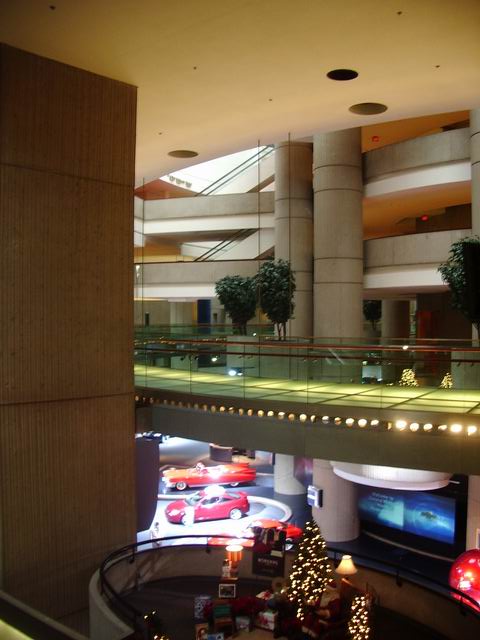
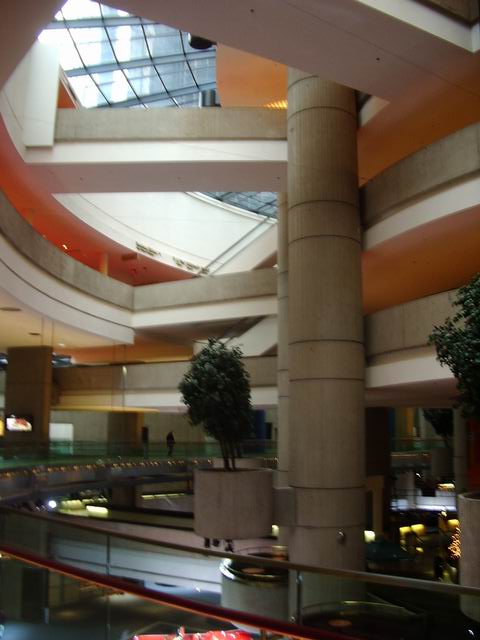
Like the shopping mall, the interior is a confusing maze of ramps and escalators. It's organized around various rings, which may have seemed cool to the architect, perhaps a Dante or Wagner fan, but left me hoping he would spend an eternity in hell going in circles. The main ring is called the "circulation ring." Essentially, you go around and around in circles until you figure out which way you need to turn to go where you want to go. The lobby to the hotel is not on the first floor, but on the third. The first is not the first. The elevator from the first to the third is not the one to your room. And you can't get to one set of elevators directly from the other. If you enter the building from another side, you must navigate various rings and levels and escalators to get to the circulation ring, and then figure out how to get from there to the main elevator core, which is in turn divided into two sets of elevators: those going to floors 9 through 40 and those going from floors 40 through 70. Melanie and I spent many hours trying to get off the damn circulation ring.
The confusing design of the Renaissance Marriott is somewhat mitigated by its staff. These are some of the nicest hotel staff I've ever met. Every person was extremely helpful. Each employee was friendly, and we were greeted with hellos and welcomes from everyone we met, down to the janitors. The restaurant staff were also friendly and accommodating. It would be great if this were the standard for all Marriott hotels.
For dinner, we decided not to venture beyond the orbit of the hotel. We went to a restaurant inside the Renaissance Center called Seldom Blues. The hostess was nice enough to squeeze us in without a reservation. The restaurant has live music, and a nice, very upscale menu. Apparently, Seldom Blues is one of Detroit's happening places. The food and the service were quite good, although a bit pricey by my standards. The first performer was a jazz pianist who played a bunch of standards. She was an older black woman, completely decked out with an elegant black dress and a large and bizarre headpiece. If only she were a drag queen, the show would have been complete. She was followed by a jazz band led by Randy Scott. It was a very talented group. Randy plays a variety of saxophones. We enjoyed the show and the dinner.
* * * * *
Our second day in Detroit proved more of a disaster. After a nice breakfast buffet in the hotel, we went to the concierge for more suggestions.
"Have you tried the Detroit Institute of Arts?"
"Yeah, we did that yesterday."
"Ah. Ya'll done and gone done it all, then."
"What about the Motown Museum?"
"It's closed on Sunday."
"Oh."
"Maybe you want to go bowling?"
"I don't think so."
"I'm trying to think what I'd want to do. How about ice skating?"
"Probably not."
"Play pool?"
"Not really."
"Hmm."
"Is there anywhere to do some shopping downtown?"
"Naw. It's all closed on Sunday."
"I see."
"Sorry."
Melanie and I looked at each other. We decided to take a ride on the People Mover, an elevated train that makes a loop around downtown Detroit. Alas, the People Mover didn't open until noon on Sundays.
Melanie wanted to get a prescription filled, so we went back to the concierge.
"Well, you'll probably have to take a taxi, because the CVS near here is closed on Sundays. It's about a five minute cab ride."
Since we had nothing better to do, we figured we'd walk to the pharmacy. A five minute cab ride should be about a twenty minute walk, and after last night's dinner and this morning's breakfast, we needed to walk a bit.
In retrospect, taking a Sunday stroll around downtown Detroit was not the best of ideas. One block away from the Renaissance Center, and things went downhill quickly. We headed east on Jefferson Avenue. The further we went, the worse the surroundings got. There were more abandoned and derelict buildings. Not many cars passed by. Other pedestrians were definitely "salt of the earth." It was a cold morning, and the CVS seemed quite a bit further than twenty minutes walking. Across from the Detroit Academy for Arts and Sciences, we saw a worn down storefront that had a sign in the door, "No Loitring." Clearly, the owner hadn't finished the Detroit Academy of Arts and Sciences.
Finally, we made it to the pharmacy, but the whole trip was in vain. They wouldn't accept a prescription written by a Dubai-based physician. And so we headed back to the hotel.
* * * * *
After a few orbits around the circulation ring, we finally figured out where the People Mover was. We paid our 50-cent fare, and boarded the train. The only other passengers riding the People Mover were a lovey-dovey couple and a bum who stunk up half the car. The love-birds got off two stops later at Greektown, leaving us with the homeless man for half of the loop.
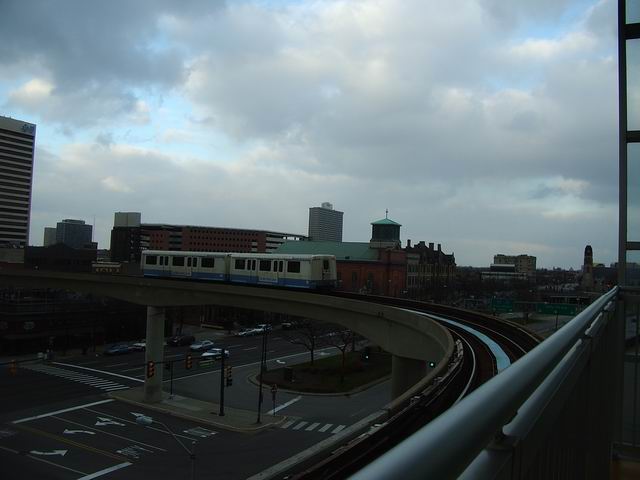
The People Mover seems to be a good idea gone bad, like so many urban renewal efforts. It's a great idea to have a means of transport for tourists. But it would be helpful if that transport actually had places to take tourists. The entire trip around downtown Detroit took about ten minutes. Six stops after the bum left us, we were back where we started.
The People Mover could be a great way to show off a city. But first you have to have things to show off. In fact, Detroit might be better off if the People Mover were underground. By being high up, it gives passengers a greater view of the city. I'm not sure that's a good thing. We had terrific views of gritty streets and abandoned buildings. Melanie, who's traveled all over the Middle East, commented, "It's like Beirut without the live shells." Indeed, our loop around Detroit was a depressing testament to a dying city.
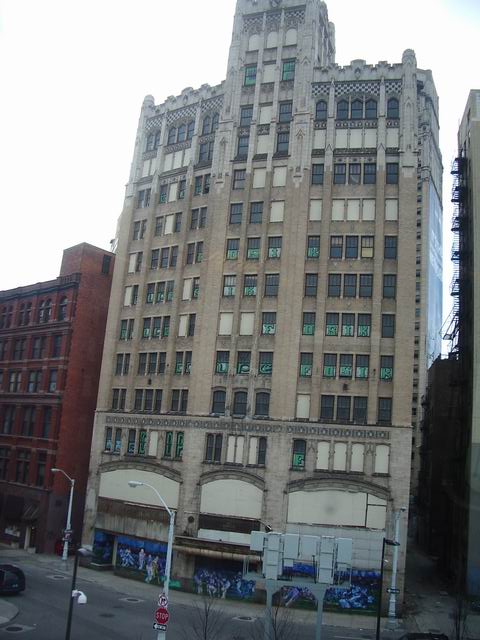
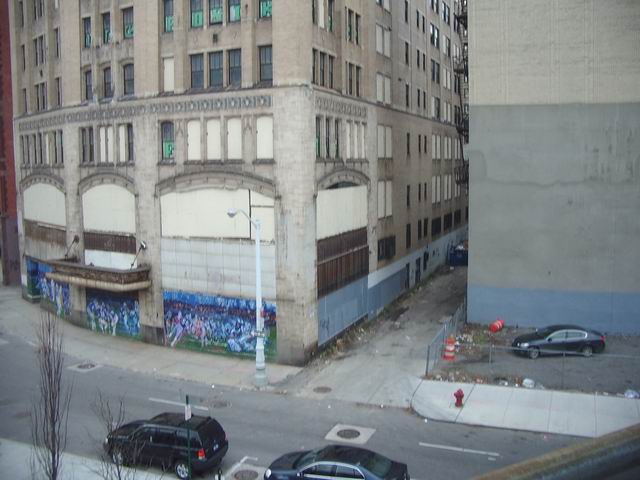
After the first loop, we continued back to Greektown. It seemed to be the only part of downtown with any signs of activity whatsoever.
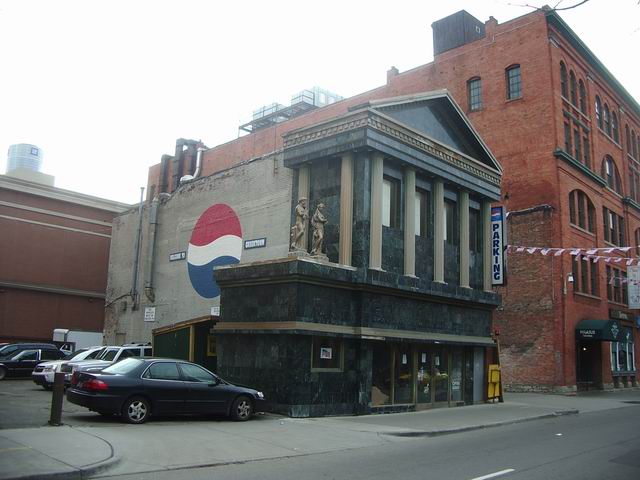
We walked through the entrance from the People Mover, and we were shocked to find a casino. I guess laws have changed, and any city can build a casino these days.
The real shocker was that the casino was packed! The streets of Detroit were empty, but on this Sunday afternoon, the gambling halls were filled. Some people were even in their Sunday finest, apparently following their church ablutions with the hopes that God might favor them with a cash bonanza at the Greektown Casino.
Melanie and I wandered the smoke-filled, people-filled casinos. It was much larger than we expected, and it was packed. It was quite a shocker.
Casinos are the death knell to urban development. It's what communities do when nothing else has worked, as is clearly the case in Detroit. And it's amazing how well casinos work. But you really have to question what benefit they will bring to the city. Tax revenues will go up, for sure. But the demographic that goes to these types of casinos are hardly high-rollers who can afford to spend their modest incomes on slots and roulette. There may be some job creation, but it's hardly a productive sector and the wages are unlikely to be very good. Casinos may also create jobs in secondary service sectors, such as restaurants and hotels, but these are also lower wage positions. Worst of all, as casinos proliferate in poor cities and Native American reservations, the marginal value of the casinos will also decrease because they will compete against each other more and more. It's really hard to imagine that Greektown, Detroit, such as it still survives, will contribute much to the city's long-term development.
* * * * *
As our twenty-four hours in Detroit came to a close, Melanie and I, somewhat bewildered, returned to the hotel. We grabbed my things so I could get to the bus between Detroit and Windsor. For some reason, the schedule we had was wrong, and we just missed the bus, leaving one last misadventure before I left.
With no other option for me to catch my train, Melanie put me on a taxi, which would take me across the border for $55! And I thought we were done with taxis!
Candidate #4 for Detroit's craziest cab driver was a religious man. He had three crosses and a "Jesus loves you!" sign hanging from his rear-view mirror. An open bible lay across the dash. I prayed that he wouldn't look for inspiration while driving. Cabbie-for-Christ drove with the heat turned on high, the windows closed, and a cigarette in a holder hanging out his mouth.
"Where you headed to from Windsor?"
"Toronto."
"Oh, Toronto. That's a nice city. I haven't been there in a long time, but it's a nice city, pretty cold right now, but it's been a while since I've been there, but it's pretty nice, right?"
He then proceeded to tell me that he needed to get back to the hotel because he was waiting for another fare. This was apparently some guy who had paid him in advance. The gentleman was also an alcoholic who had already drunk a case of beer. I thanked the reverend for the information.
When we got to the Canadian checkpoint, the cabbie decided to share this information with the immigration agent. Unfortunately, not much of what the taxi driver had to say was very coherent, and all the agent heard was "He's got a case of beer."
"What's that about a case of beer?" he asked, looking a bit alarmed. Then he looked at me sternly.
"He drunk a whole case of beer, I tell you!"
Mortified, I told the agent that he's talking about another fare, not me. Confused, the agent waved us through, and the cabbie sped through Windsor to get me to the train station. I guess he had faith in a higher power, because his driving almost got us killed.
My friend Ejiro, a Detroit loyalist, will once again scold me, saying that twenty-four hours isn't enough to judge her hometown. But it was more than enough for me.
We drove along the river front, and I looked out at the skyline of Detroit. Part of me felt sad for the Windsorians who had to spend glum winter days looking at the decrepit city. On the other hand, I thought, it doesn't look so bad from a distance, separated by a river and a national border. Perhaps that's how Detroit should be experienced...in small doses and from a distance...quite a distance. .
I boarded my train and happily sped away, away from Detroit back to Toronto. A nice city, a good city, one in which I hadn't been in for just over twenty four hours, but it felt like years. Ahh, it'll be good to be back, I thought, and relaxed as the train put more distance between me and Detroit.
Powered by Qumana
Comments
What a story!!! I'm glad you got to see Melanie, but sad to hear of your misadventures!
Thanks for the descriptive narrative about Detroit.
xxoo
Posted by: Tasha | December 5, 2006 03:14 PM
Excellent story - hope you enjoyed your time with your friend. It's true all the development has moved outside the city of Detroit.
Posted by: Michael | December 6, 2006 02:58 PM